The Memory of Paths 🍎
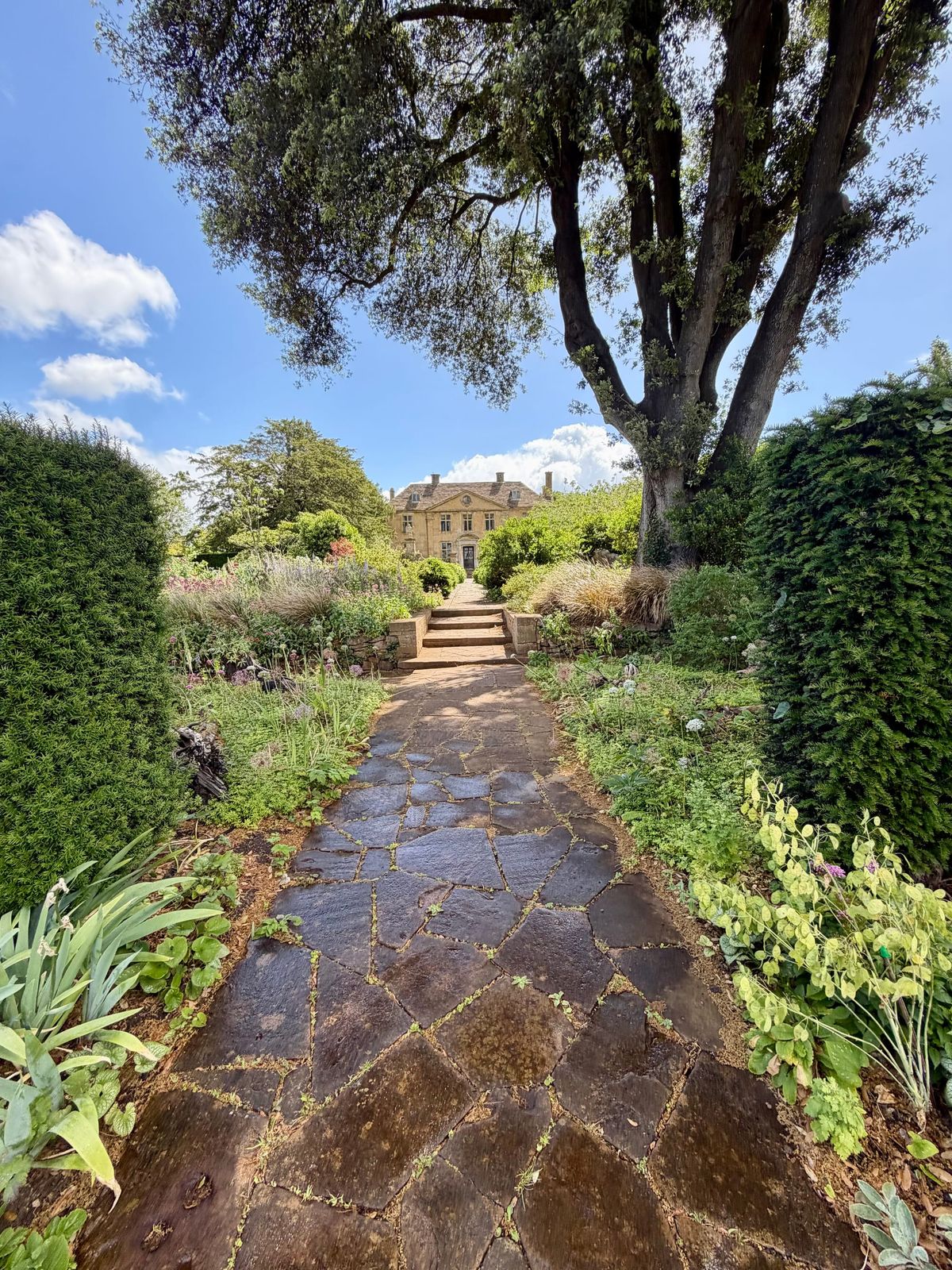
At Barrington Court, the paths seem older than the gardens.
This is not literally true, of course. The avenues, orchards, walls, and flower borders have all been shaped by human hands. Yet the paths possess a different quality. They feel less constructed than remembered. The long avenue stretching away from the manor house, the grass tracks wandering through meadows, the narrow routes disappearing beneath apple trees: each seems worn into existence by repetition. One imagines generations of feet passing over the same ground until memory itself acquires a physical form.
Looking back through my photographs that evening, I realised that almost every image contained a path.
At first I thought I had been photographing gardens.
Only later did I realise I had been photographing journeys.
Somerset is particularly suited to such reflections. These are not landscapes that overwhelm. They do not possess the immediate grandeur of mountains or coastlines. Their beauty emerges gradually through orchards, church towers, hedgerows, old stone walls, and lanes sunk so deeply into the earth that they seem less like roads than shallow rivers cut through time. They invite movement rather than astonishment. They ask not to be admired from afar, but followed.
Walking through the gardens, I found myself thinking about how many different kinds of walking exist. The English language is surprisingly poor here. We walk to work, walk home, walk away, walk towards. Yet each movement conceals a different understanding of what it means to travel through the world.
The Greeks, as so often, were more precise.
🛤️ Πορεύομαι: To Proceed
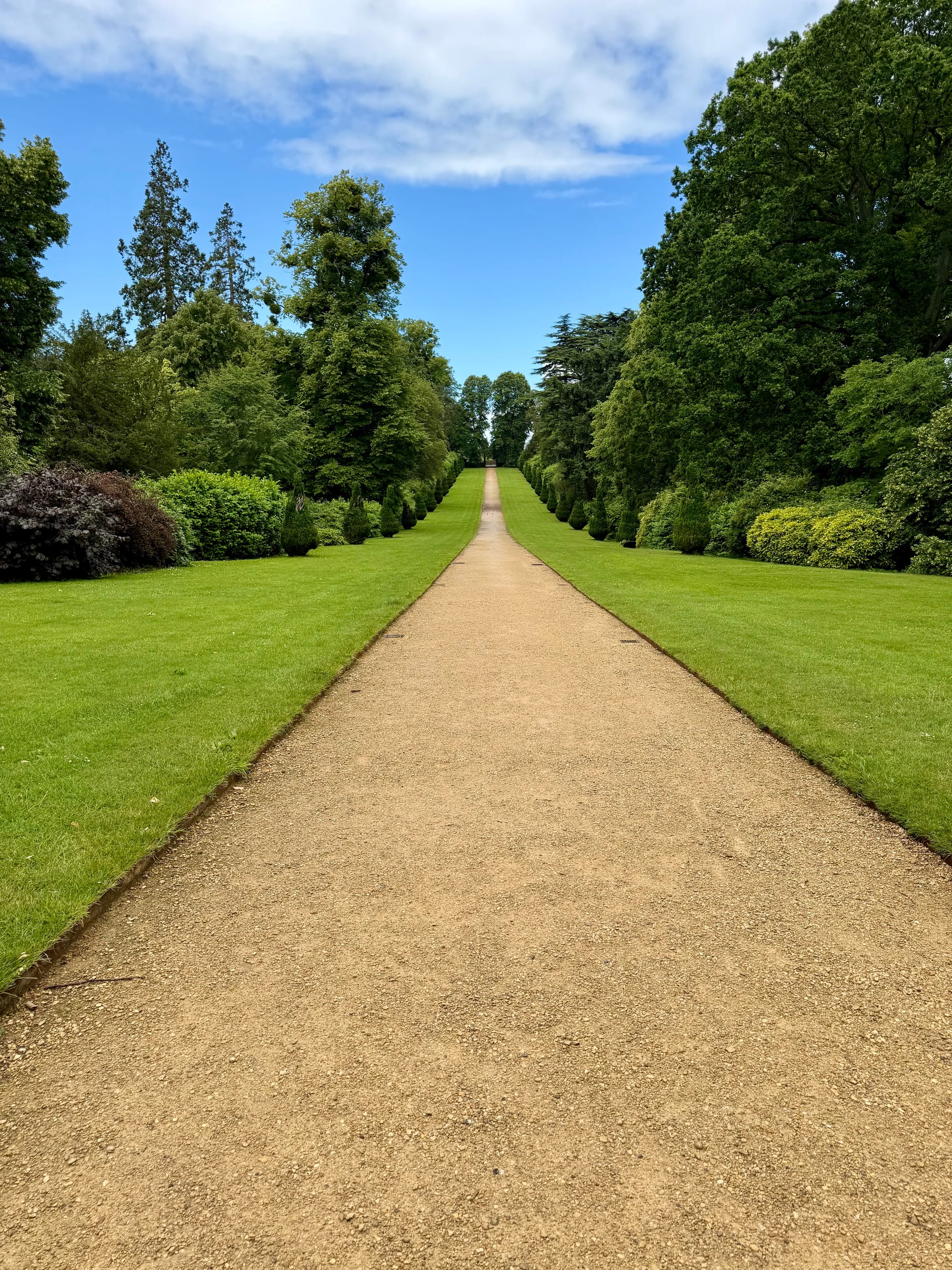
The great avenue at Barrington Court runs through the landscape with almost complete confidence.
Straight. Ordered. Purposeful.
The clipped hedges and measured symmetry create the impression that the path knows exactly where it is going. Looking down it, I found myself thinking of the Greek verb πορεύομαι.
The word means more than simply “to walk”. It suggests proceeding, advancing, making one’s way. It is the verb of pilgrims, travellers, disciples, and exiles. Throughout Scripture, people are forever πορευόμενοι: leaving familiar places behind, crossing deserts, moving towards destinations they cannot yet fully see.
There is something deeply reassuring about such paths.
Perhaps because they resemble the lives we imagine for ourselves when we are young. Education leads to vocation. Decisions produce outcomes. Effort yields reward. The future stretches visibly ahead like an avenue through a formal garden.
Barrington Court embodies this dream beautifully.
The avenue is a triumph of intention. It represents a specifically human desire to impose order upon uncertainty, to transform the unpredictability of nature into geometry. Every tree appears where it ought to be. Every line moves towards a visible destination.
Yet only a few minutes beyond the avenue, another vision of life begins to emerge.
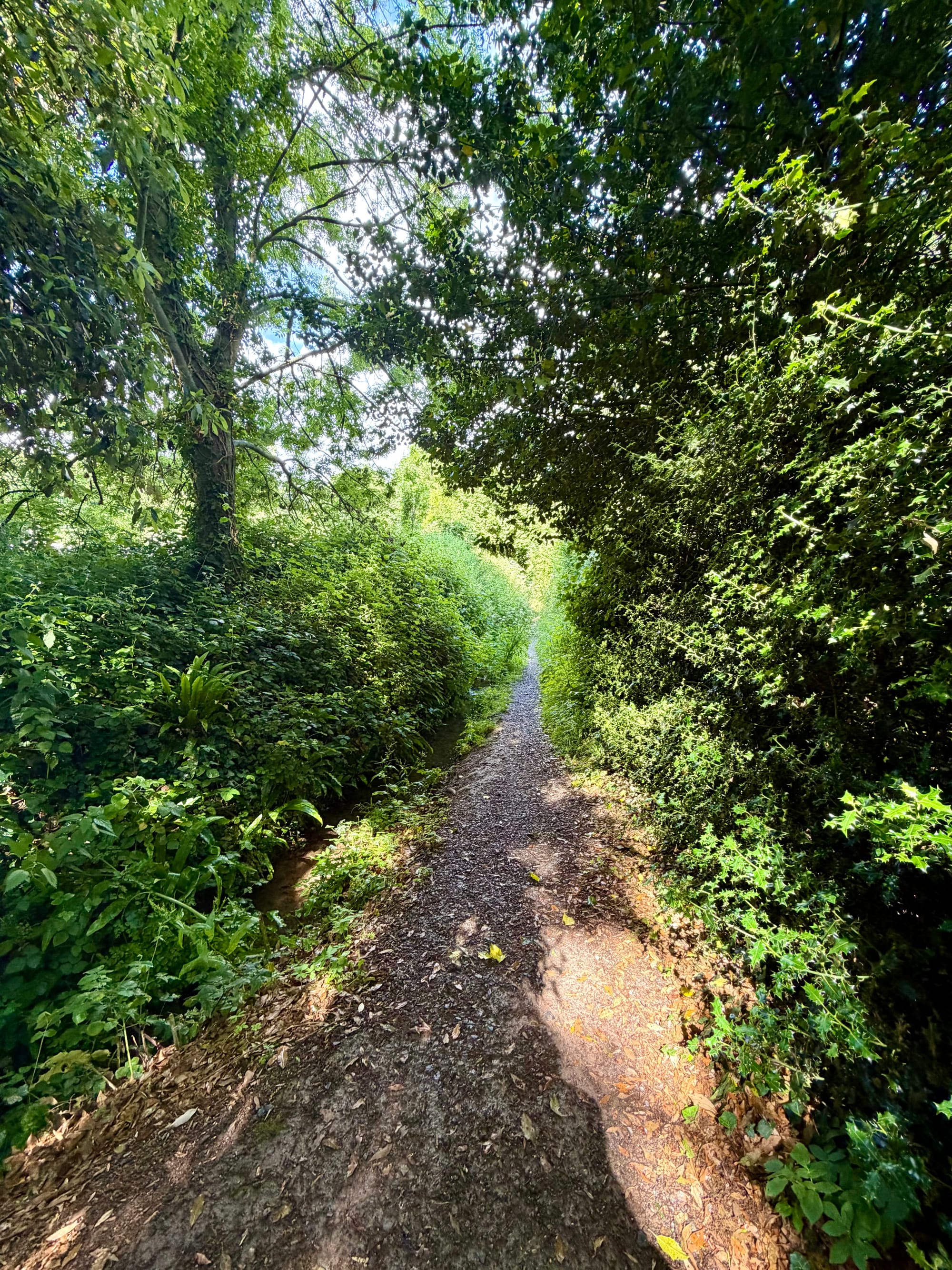
The gravel gives way to grass. The route bends. Trees obscure the horizon. The next turn conceals everything beyond it.
One can no longer see where the path leads.
Most lives, I suspect, resemble these narrower paths far more closely than they resemble avenues. We rarely possess a complete map. At best, we are granted enough visibility for the next few steps.
The avenue promises arrival. The orchard, as I would later discover, speaks a different language altogether.
👁️ Θεωρέω: To Behold
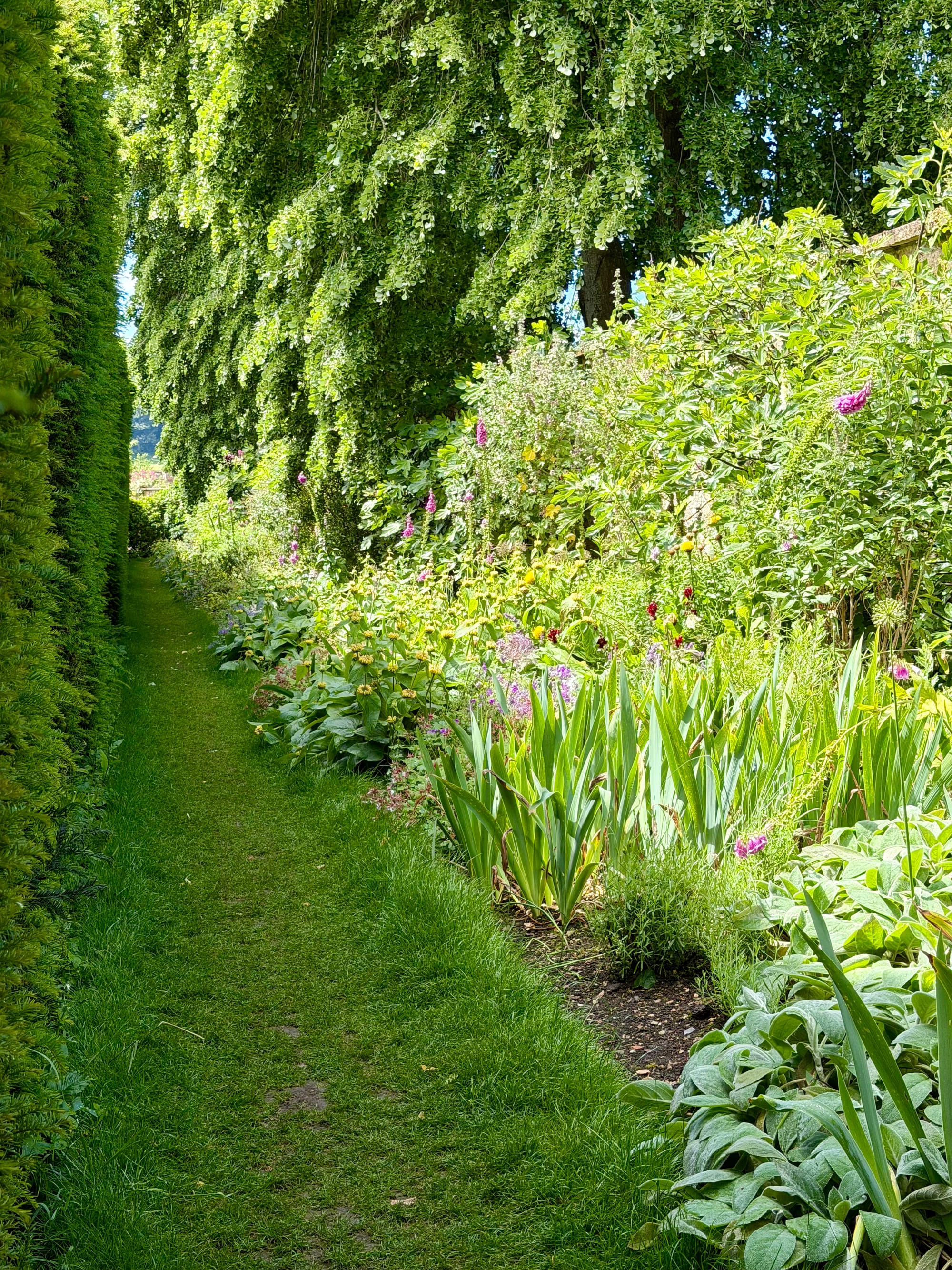
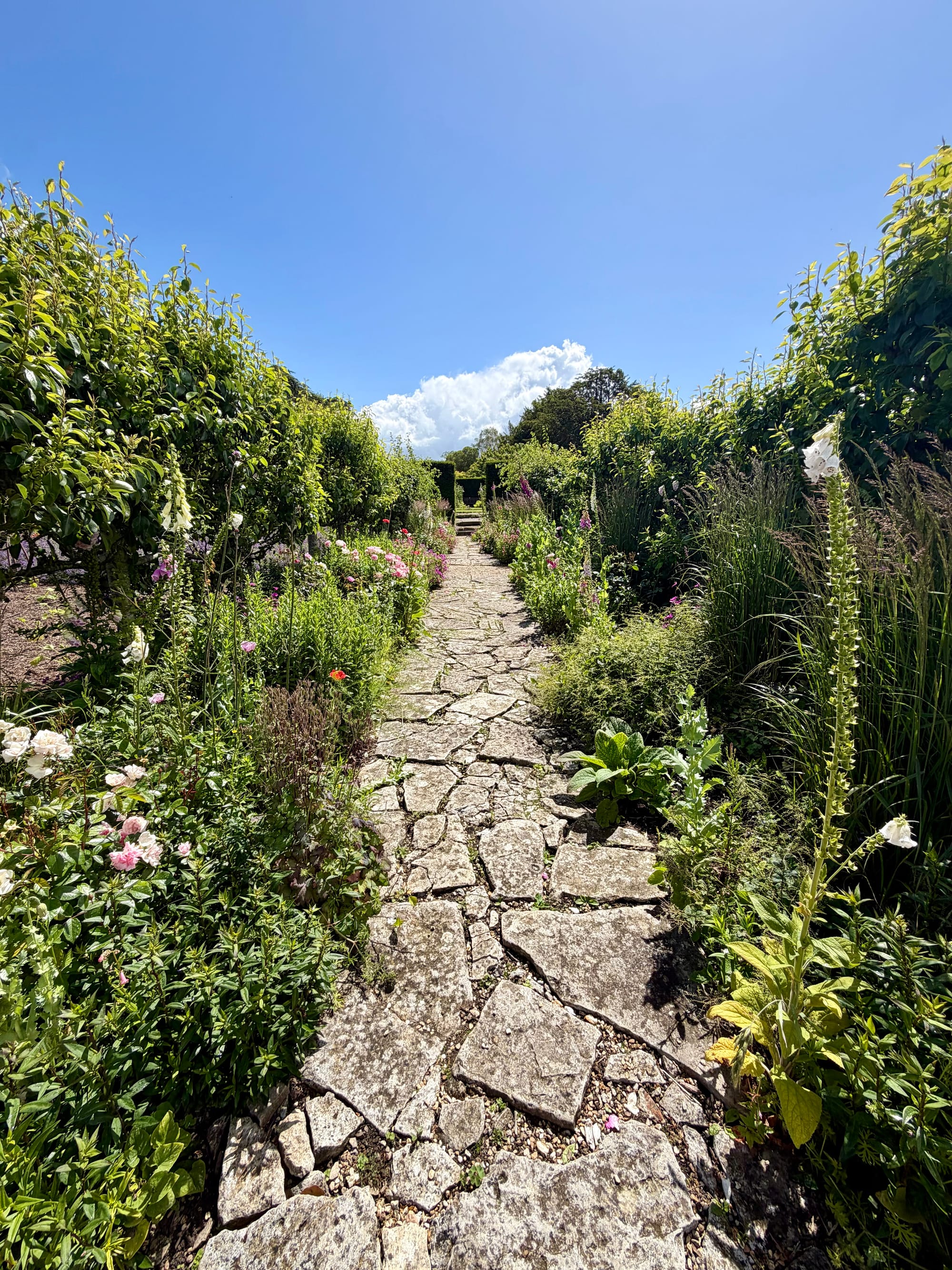
As the paths narrowed beneath trees and between flower borders, another Greek verb came to mind.
θεωρέω.
Today we inherit the word as “theory”, a term that suggests abstraction and distance. Yet its original meaning was almost the opposite. A θεωρός was someone who travelled in order to witness sacred festivals and public ceremonies. Theory began not as detached speculation but as attentive seeing.
One journeyed in order to behold.
There is something profoundly attractive about that idea in an age obsessed with speed.
Modern travel often encourages acquisition. We collect countries, museums, UNESCO sites, and photographs. We hurry from one destination to another with the faint anxiety that we may be missing something elsewhere.
Barrington Court resists this impulse.
Nothing here demands attention. There are no dramatic vistas. No overwhelming monuments. Instead there are roses climbing warm brick walls, lavender attracting bees, shadows drifting across gravel, and sunlight filtering through leaves. The church tower rises intermittently above the trees, appearing and disappearing as one moves through the gardens, less a destination than a reminder that people have been walking these paths for centuries.
The garden rewards patience.
The longer one remains, the more one notices.
A branch extends at an unexpected angle. A patch of sunlight moves gradually across a path. The scent of flowers appears and disappears with the breeze. The eye begins to linger. Small details emerge from the background. The ordinary acquires depth.
Walking becomes a discipline of attention.
Perhaps this is why pilgrimage remains such a powerful religious image. The pilgrim does not simply move through space. He learns to see differently. The road slows the body and, in doing so, slows the mind. Things overlooked in haste become visible.
The path teaches the eye how to look.
🌿 Φοιτάω: To Return
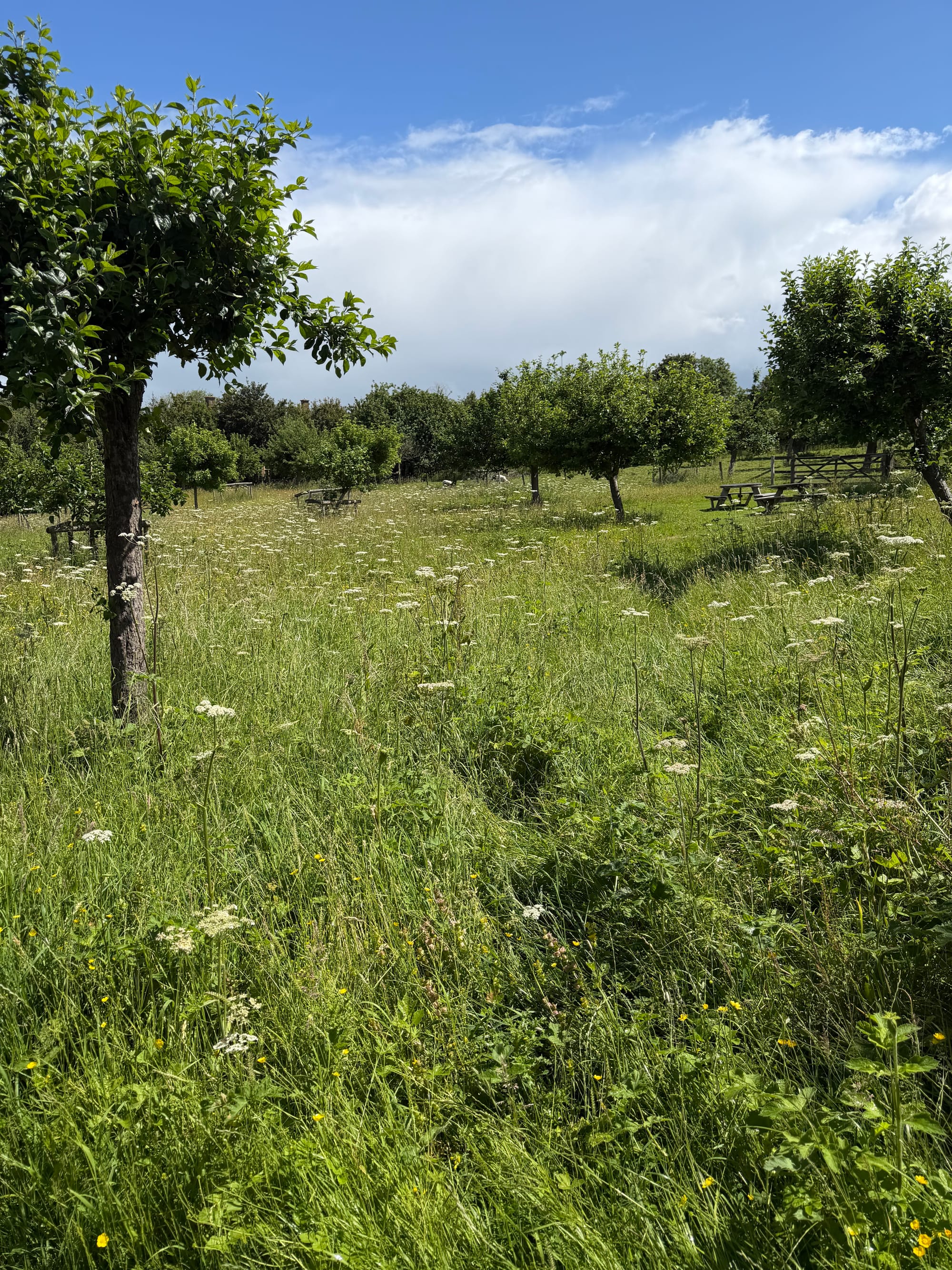
Further into the gardens, the paths wandered through meadow grass and beneath overhanging branches.
Here another verb suggested itself.
φοιτάω.
To return repeatedly.
To revisit.
To haunt and to be haunted.
It is one of the most beautiful words in Greek because it captures something that happens long after a journey has ended.
Most places disappear from memory almost immediately. Hotels blur together. Roads are forgotten. Even photographs lose much of their power. Yet certain landscapes remain.
Not because they are extraordinary.
Because they enter the imagination quietly.
The orchard at Barrington Court seemed to possess precisely this quality.
There was nothing dramatic about it. The apples hung beneath broad leaves. Sunlight moved gently through the branches. The paths wound softly between the trees. Somewhere beyond the orchard, the church bell sounded across the fields, and then the sound faded again into the afternoon.
Yet I suspect I shall remember the orchard long after I have forgotten more spectacular places.
Perhaps because orchards themselves are places of recurrence.
The same trees endure year after year. Blossom returns each spring. Fruit appears each summer. Harvest follows. Then winter. Then blossom once more.
The orchard lives by return.
The avenue and the orchard seemed to embody two competing visions of life.
The avenue speaks the language of progress. One moves forward towards a destination.
The orchard speaks the language of seasons. One returns.
Growth occurs not through linear advancement but through repetition. The same commitments, the same relationships, the same acts of care performed again and again until they become part of who we are.
A path exists for much the same reason.
Someone walked there once.
Then again.
Then again.
Eventually memory becomes geography.
A path is simply repetition made visible.
🍏 Κατανύσσομαι: To Be Pierced
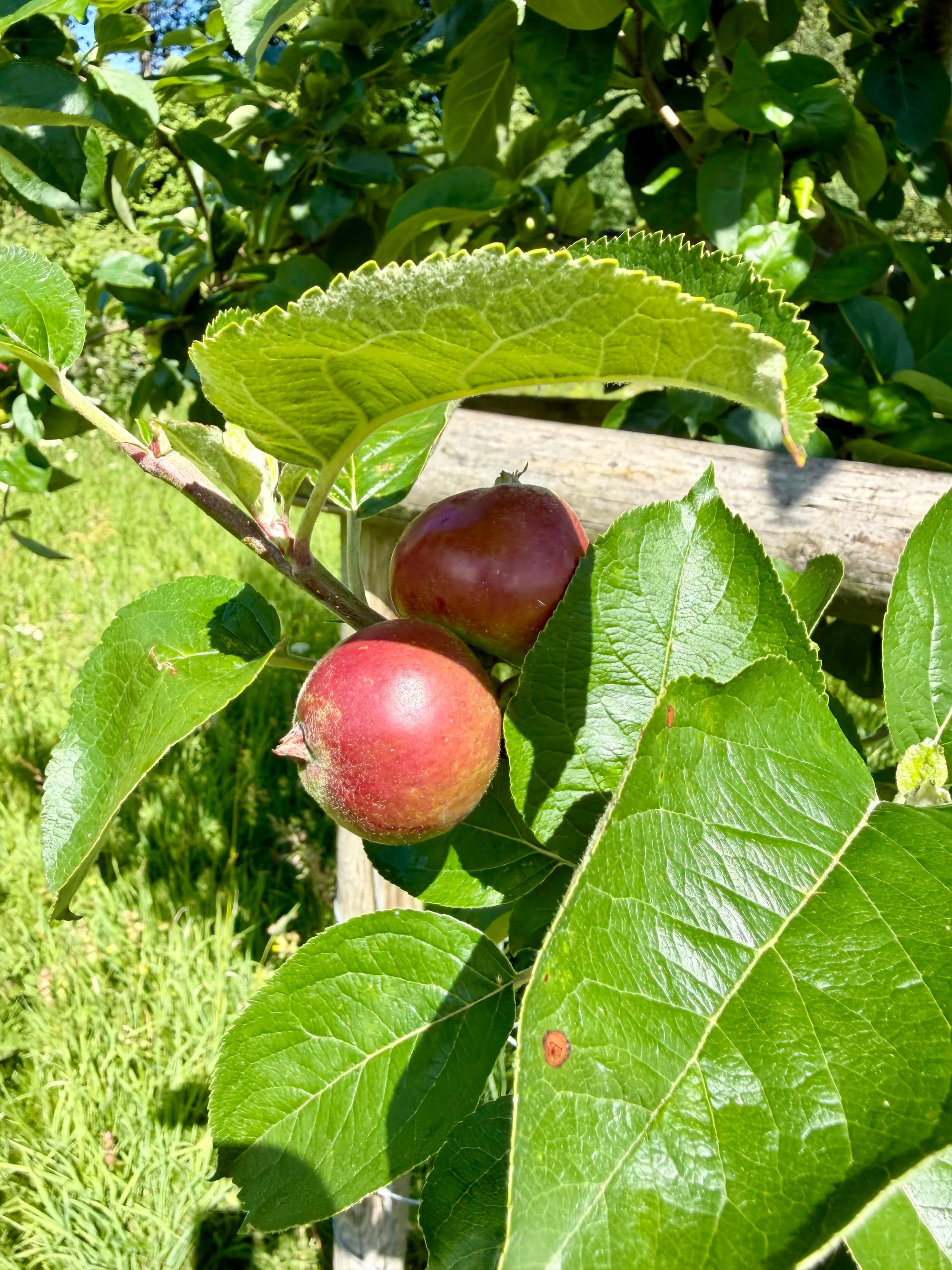
Near the orchard I stopped beside two apples hanging beneath broad green leaves.
They were not yet ripe.
Suspended between blossom and harvest.
Between possibility and fulfilment.
Looking at them, I found myself thinking of another Greek verb.
κατανύσσομαι.
The word appears in the Acts of the Apostles when Peter’s listeners are described as being “pierced to the heart”. Not persuaded. Not convinced.
Pierced.
The image is remarkable because it suggests that certain truths reach us before we are fully capable of explaining them. They wound before they convince. They disturb before they clarify.
The apples produced something similar.
Not because of their beauty, but because of their incompleteness.
They had not yet become what they would become.
We are conditioned to admire fulfilment. Ripeness. Completion. Arrival. Yet nature rarely operates in such a manner. The apple exists for transformation. It flowers, ripens, falls, ferments, decays, nourishes. Each stage requires the abandonment of the previous one.
The fruit fulfils itself by ceasing to remain what it was.
Somerset understands this instinctively.
For centuries these orchards have not merely grown apples. They have transformed them. Fruit becomes cider through fermentation, a process dependent upon time, alteration, and surrender. The landscape itself participates in a cycle of becoming.
Sweetness becomes something richer.
Standing beneath the branches, I found the image unexpectedly moving. Not because it offered an answer, but because it refused one. The apples remained unfinished. Their purpose still lay ahead of them. They existed within a process rather than at its conclusion.
Perhaps that was what made them beautiful.
🚶 Camminare
For eight years in Rome there was one word that seemed impossible to escape.
Camminare.
To walk.
To journey.
To make one’s way.
Under Pope Francis the word became almost a refrain. The Church was called to camminare insieme: to walk together. Faith itself was described less as a possession than as a journey. At times the repetition became almost comic. One could attend enough meetings, conferences, synods, and retreats to predict when the word would appear.
Yet walking through the paths of Somerset, I found myself returning to it with greater sympathy than I once possessed.
There is a peculiar honesty to walking.
One cannot walk yesterday’s road.
One cannot walk tomorrow’s road.
One can only walk the stretch immediately before one’s feet.
Perhaps this is why pilgrimage remains such a powerful religious image. It transforms faith from certainty into trust. The pilgrim does not possess complete knowledge of the journey. He possesses only the willingness to continue.
Dante understood this when he began the Divina Commedia not with an arrival but with a road:
“Nel mezzo del cammin di nostra vita…”
“Midway along the journey of our life.”
Not the destination.
The journey itself.
Looking back through the photographs later that evening, I realised that every path I had captured expressed some variation of this truth.
The avenue.
The orchard.
The meadow track.
The doorway.
Each suggested movement rather than completion.
🚪 The Open Gate
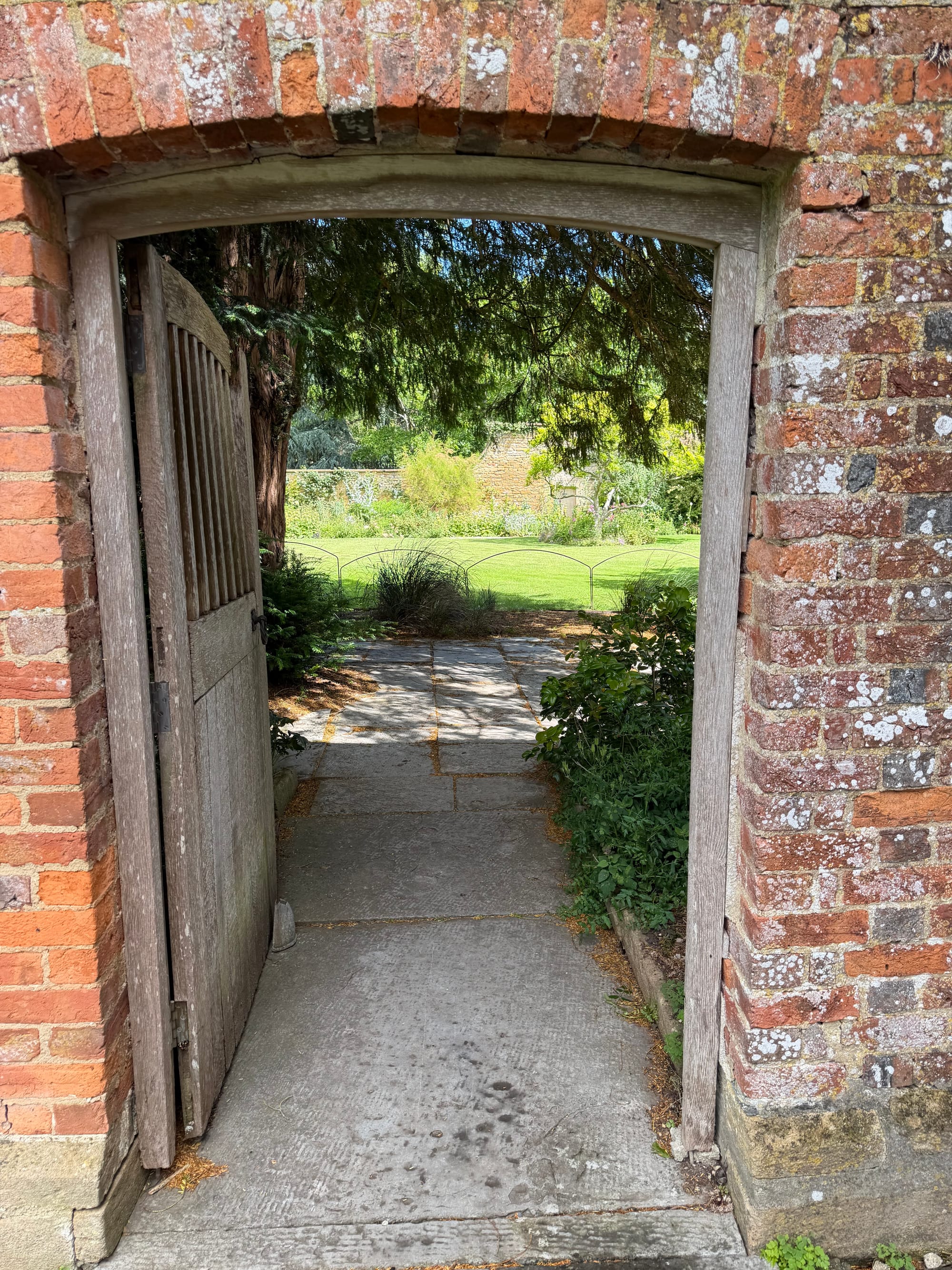
Near the end of the afternoon I passed through an old brick doorway set into a garden wall.
Beyond it another path disappeared beneath trees.
There was nothing especially remarkable about the scene. No grand monument. No dramatic vista. Merely an opening and a way beyond it.
Yet it remained with me more than almost anything else I photographed that day.
Perhaps because we spend much of our lives imagining that transformation will announce itself dramatically. We expect revelations, turning points, decisive moments. More often, change arrives quietly. It hides within ordinary thresholds. We pass through them almost absent-mindedly and only later realise that an entire chapter of life began there.
A doorway.
A departure.
A road taken without fully understanding where it would lead.
As I left Barrington Court, I passed the orchard one final time. The apples were still hanging beneath the leaves exactly as they had been an hour before. Nothing in the landscape had changed. The avenue remained straight. The church tower still rose above the trees. The paths still wound through the grass as they had for generations.
Yet I found myself looking back.
It was not because there was anything more to see. The orchard had already revealed itself fully. The afternoon had offered no revelation, no dramatic insight, no decisive moment of understanding. If anything, its gifts had been quieter than that.
Perhaps this is why the Greek verb φοιτάω returned to me. The word does not simply describe a physical return. It suggests the curious way in which certain places continue to accompany us after we have left them behind. Long before we revisit them in reality, we have already revisited them many times in memory.