Where the Dead Listen: Walking Ok-no-in
“The past is never dead. It’s not even past.”
— William Faulkner
In the shadowed heart of Mount Kōya, where the cedars rise like pillars of an ancient cathedral, lies Oku-no-in, Japan’s largest cemetery and one of its holiest sites. I walked into it not as a pilgrim, but as a guest, uncertain of the line between reverence and intrusion, between belief and witnessing.
It is said that Kūkai, known posthumously as Kōbō Daishi, the founder of Shingon Buddhism, remains here in eternal meditation, not dead, but awaiting the arrival of the future Buddha. This idea is hard to grasp intellectually, but walking the forest path toward his mausoleum, I began to understand it emotionally. The silence here doesn’t feel empty; it feels listening.
Green Silence and Stone Grief
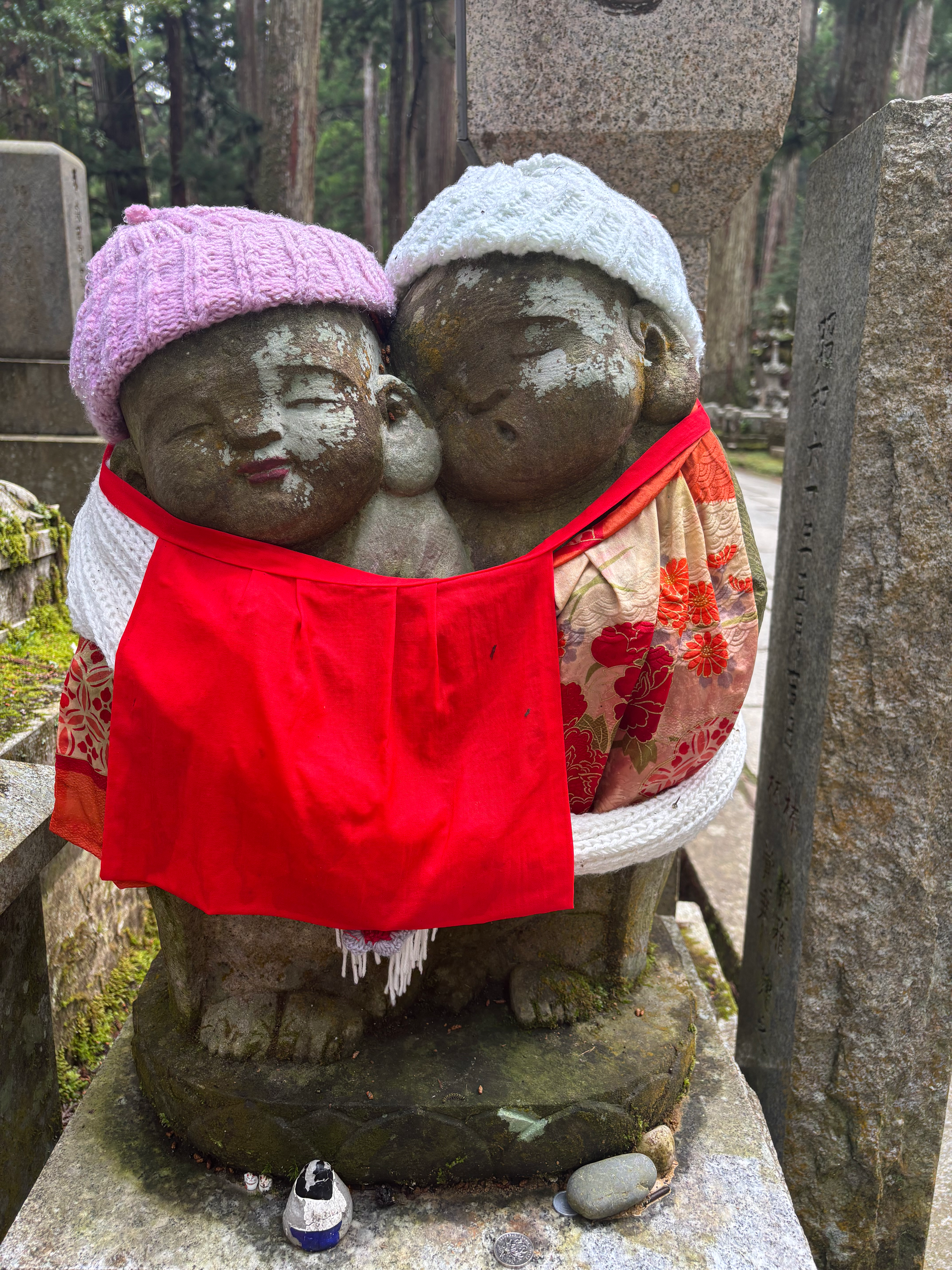
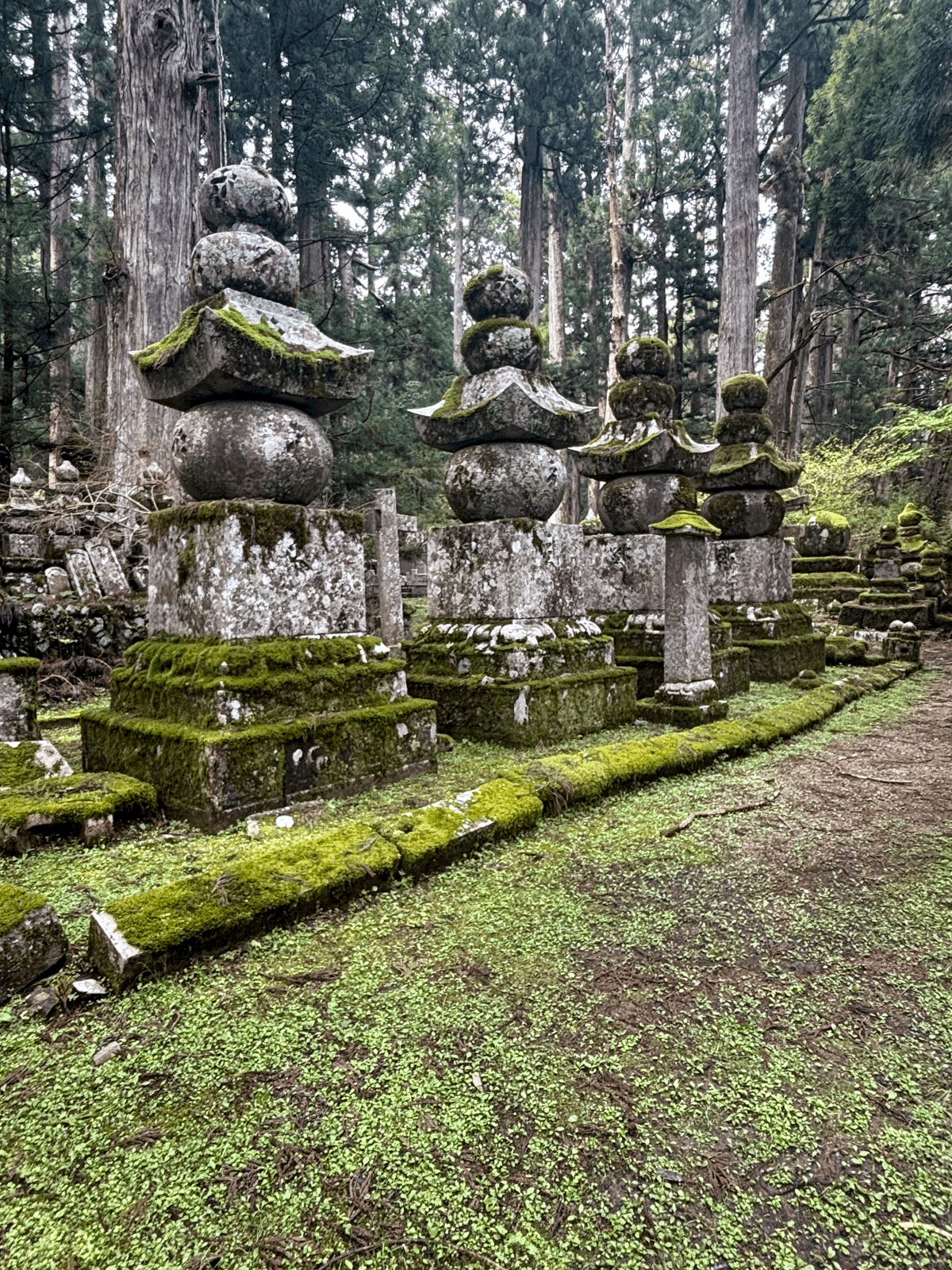
The path is flanked by stone stupas, leaning with age, their inscriptions softened by time. Moss clings like memory, covering everything in a soft, living hush. Hundreds of thousands of Jizō Bodhisattvas stand vigil throughout the grounds, swaddled in red bibs and hand-knit bonnets, protectors of children who never arrived and travellers who never returned. There is tenderness in their small, round faces, but also a kind of spectral sorrow as if grief has shaped itself into stone and quietly waits to be seen.
I found myself moved in ways I didn’t expect. The forest hums not just with the chants of monks or rustle of branches, but with the ache of remembering of being remembered. This is not a cemetery in the Western sense; it’s not about endings. It’s about continuity. The dead are not gone here. They are present, and maybe even aware.
Between Faiths
As a Catholic, I arrived carrying my own symbols: saints, sacraments, silence. But in this space, I found something startlingly familiar, not in theology, but in gesture. The bowing. The offerings. The reverence for the unseen. And, most unexpectedly, the smell of incense, foreign and sacred, yet impossibly familiar. It disoriented me at first, that I could be so far from home and yet be transported instantly to the hush after Mass, to the lingering sweetness of a church thick with old wood and prayers.
I did not trespass, but I did recognise. Not through syncretism, but through the ache of spiritual recognition; the quiet realisation that beneath all dogma, the human heart reaches in the same direction. Toward mystery. Toward mercy. Toward meaning.
Here, the veil felt thin. And in that thinness, I did not find fear or confusion, but presence. I stood at the edge of Kūkai’s lantern-lit hall, hands folded, and felt not watched, but welcomed: not because I belonged in any doctrinal sense, but because the space itself was built to hold what cannot be named.
The Path Inward
Mono no aware (物の哀れ)
The bittersweet awareness of the impermanence of things; a gentle sadness at their passing.
On the walk back through Oku-no-in, the spell didn’t break but it began to shift. I passed vending machines humming near the entrance, tourists whispering in fractured languages, camera shutters clicking like prayer beads dropped on stone. These moments might seem profane distractions from the sacred, but here, they felt absorbed rather than resisted. Oku-no-in does not demand silence; it transforms noise.
In Shingon Buddhism, the sacred is not distant or abstract: it is immediate, embodied, immanent. There is no firm line between this world and the next; the spirit does not leave the body to ascend, it remains within form, within earth and tree and stone. Grief, then, is not rupture but relationship. The dead are not gone; they are simply changed, still here in another register of presence.
This contrasts with the Catholic grammar of grief I was raised in, where mourning often gestures heavenward, seeking reunion in a world beyond. But in this forest of stone and silence, I found myself struck by a line from Henri Nouwen, a Catholic writer whose words felt almost Eastern in their inwardness:
“Our grief is not a passage to get through but a place to dwell — a place where the heart can learn how to expand.”
That line stayed with me. Because here, in Oku-no-in, grief is not something to resolve. It is something to inhabit, to walk with through the forest, to fold gently like a letter, unread but carried. There is no need to transcend suffering in this tradition. Instead, one tends to it, like moss tends to stone: softly, patiently, without urgency.
We are not separate from the world. We are expressions of it: impermanent, yes, but never truly absent.