Tozawa and Narcissus: On Reflection, Desire, and the Self That Cannot Return
“He fell in love with an image, but it was his own.”
— Ovid, Metamorphoses, Book III
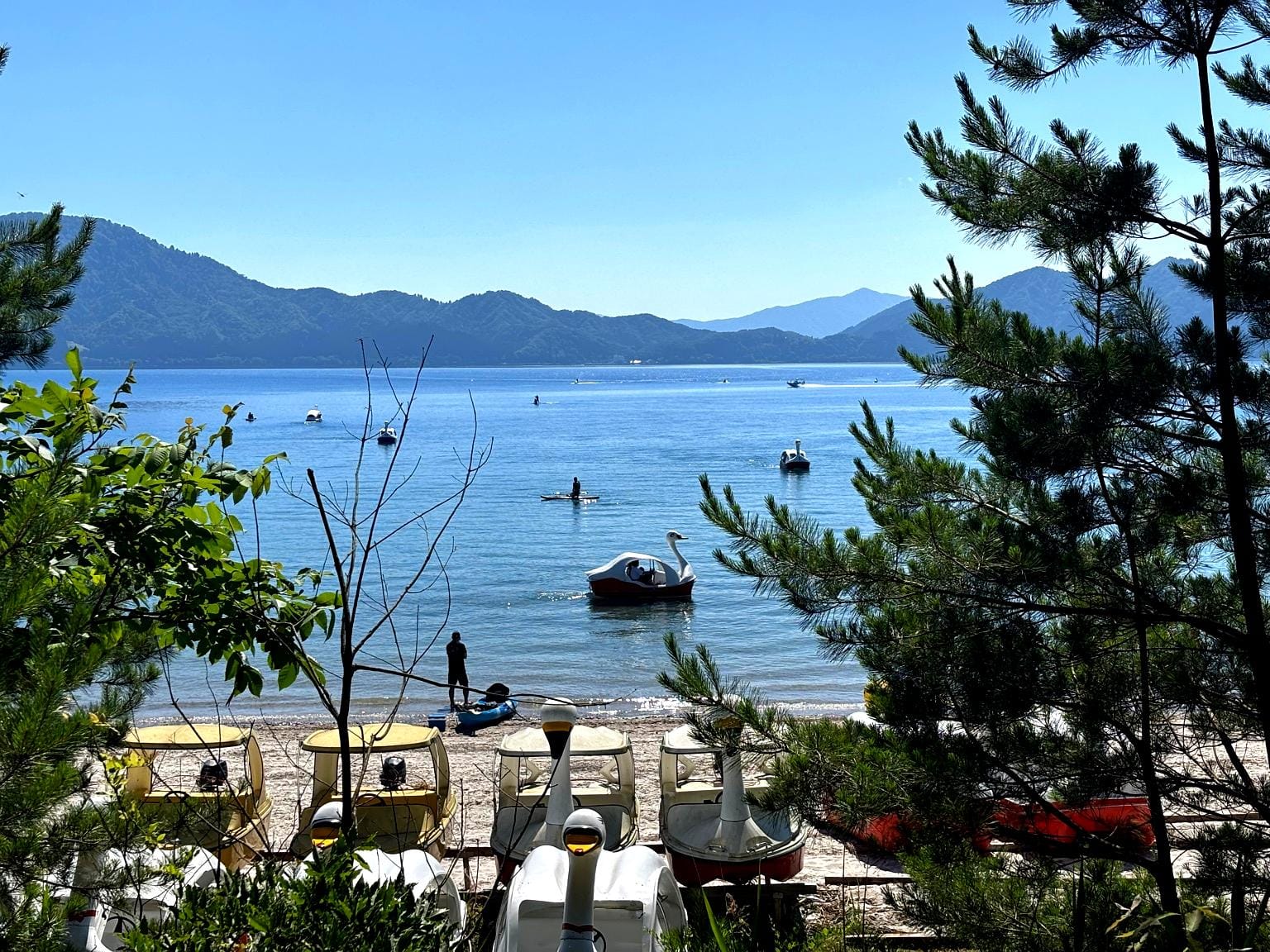
Lake Tazawa is the deepest lake in Japan. It is also, perhaps, the most unsettling. The colour of the water is impossible, cobalt , ultramarine, sometimes a disquieting black depending on the light, and yet always still. It does not freeze in winter. It does not churn. It holds.
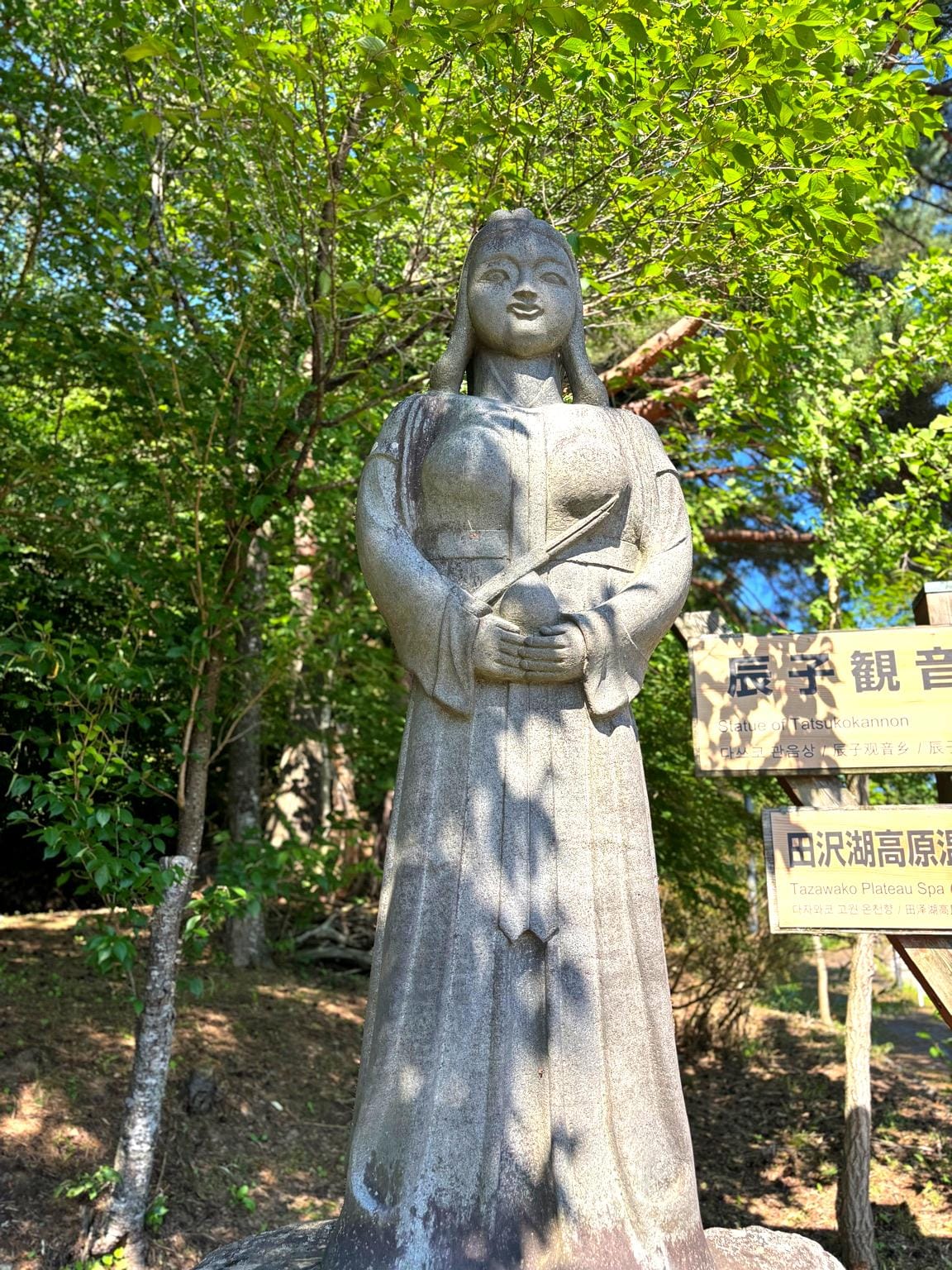
I had come in search of the famous golden statue of Tatsuko: the girl who became the lake. But I could not find her. Instead, I found a stone figure, weather-worn and silent. No polished gaze. No gold leaf. She did not shine. She absorbed. And she reminded me, not of a goddess or a heroine, but of Narcissus.
Two myths. Two waters. Two transformations. One consumed by his reflection. One erased by hers.

🧿 I. Two Myths of Reflection
Narcissus leans into a pool and sees what he has never truly known: his own face. It entrances him. But the water does not yield. It only repeats. Desire folds back on itself. Trapped in the illusion of encounter, Narcissus wastes away. He becomes not a man, but a flower. His final metamorphosis is aesthetic, not salvific. Beauty remains, but the self is gone.
Tatsuko’s story, told in the mists of Akita’s mountains, begins not with self-knowledge but with fear. She is young, beautiful, and afraid of losing that beauty. So she climbs into the sacred forest and prays to the kami to preserve her forever. The answer comes not as a mirror, but as immersion. She becomes the lake. Her features are not preserved; they are surrendered. The girl does not die. She is transfigured.
Here the myth does something subtle. In the Western telling, the self clings to its image and perishes. In the Japanese version, the self is dissolved into the world and endures. Narcissus is punished for gazing too long. Tatsuko is absorbed for praying too deeply.
Where the West reads reflection as a warning, Tozawa reads it as a passage.
🧠 II. Freud and the Mirror of the Mind
Freud’s legacy may be Western, but his concept of narcissism reaches back toward myth. To be narcissistic, for Freud, is not merely to love oneself, but to become fixed in a state where the self cannot let the world in. In early childhood, this may be natural. But when it persists into adulthood, it becomes a pathology; a closing in of the libido, a refusal to desire the other. Narcissus does not just love himself. He cannot escape himself.
Tatsuko’s arc is not narcissistic. It is, if anything, a form of sublimation. Her desire for beauty is transmuted not repressed, but granted in a different register. Her body disappears, but the lake remains: cold, perfect, endless.
Yet Freud might hesitate here. He believed that sublimation was productive only when redirected toward cultural goods: art, religion, intellect. Tatsuko’s metamorphosis is not creative. It is elemental. What she achieves is not a symbol, but a presence. In Freudian terms, she has moved beyond the economy of desire altogether. She becomes something for which the psyche has no name.
And this is where East and West begin to drift.
🌲 III. Nature as Mirror, Water as Witness
In the West, mirrors are epistemic. They disclose the self to itself. We are formed, at least in part, by recognition. Reflection is a tool of thought and often of torment. In Ovid’s world, to see oneself too clearly is to risk disintegration.
In Japanese cosmology, especially in Shinto, reflection does not always lead inward. It opens outward. Water is not a mirror, but a threshold. It contains kami, memory, spirit. To see one’s face on the surface of a lake is not to encounter an image. It is to come close to dissolution, to feel one’s individuality loosen in the presence of something older and wider than the self.
Standing at Lake Tazawa, you do not feel seen. You feel dispersed. The water gives no image. Only depth.
The statue, grey and modest gazes not into the lake but past it. She does not confront herself. She watches something else: time, wind, snow. Her beauty is not preserved. It is translated. What remains is not her face. It is her absence, made permanent.
🧘 IV. The Gender of Transformation
There is another contrast here less mythical than structural. Narcissus is male, and his myth ends in withering. Tatsuko is female, and hers ends in endurance. The man is punished for fixation. The woman is taken up by the world she feared.
This is not to romanticise. Both stories efface the self. But they do so differently. The Greek tradition makes reflection an act of hubris. The Japanese tale makes it an act of reverence: misguided, perhaps, but not condemned. Tatsuko’s beauty is not devoured. It is made impersonal.
One becomes a flower. One becomes water. Both are beautiful. But only one is still here.
🌌 V. Philosophy of Water: Nishida and the Fluid Self
The Japanese philosopher Kitarō Nishida once wrote that the truest form of selfhood is pure experience; not the “I” observing the world, but the “I” disappearing into it. The self, in this view, is not a container. It is a current.
Lake Tazawa is not a mirror. It is a field of experience.
Narcissus encounters water and recoils into ego. Tatsuko enters it and ceases to be separate. In Nishida’s terms, she has not lost herself. She has become one with the form of reality itself.
There is no need, then, for a golden statue. No icon. No monument. The lake is her continuation. Not as symbol, but as being.
This is the difference. Western myths seek immortality through image. Japanese ones achieve it through disappearance.
🪷 VI. Final Reflection: What Survives the Mirror
Narcissus is undone by the image. Tatsuko is unmade by the prayer. Both seek to hold what cannot be held. Both become more than themselves and less.
The lake does not freeze. The flower does not live long. But the myths remain.
And perhaps that is the point.
What we become is not always ours to choose. But what we desire becomes part of the world. It settles into myth, into water, into silence.
At Lake Tazawa, the girl is gone. But her longing is still present. Not punished. Not glorified. Just held beneath the surface.
Still. Cold. And enduring.