The Veil of Vision: Psyche, Paris, and the Remaking of the Soul
🌒 I. Plotinus and the Lamp of the Soul
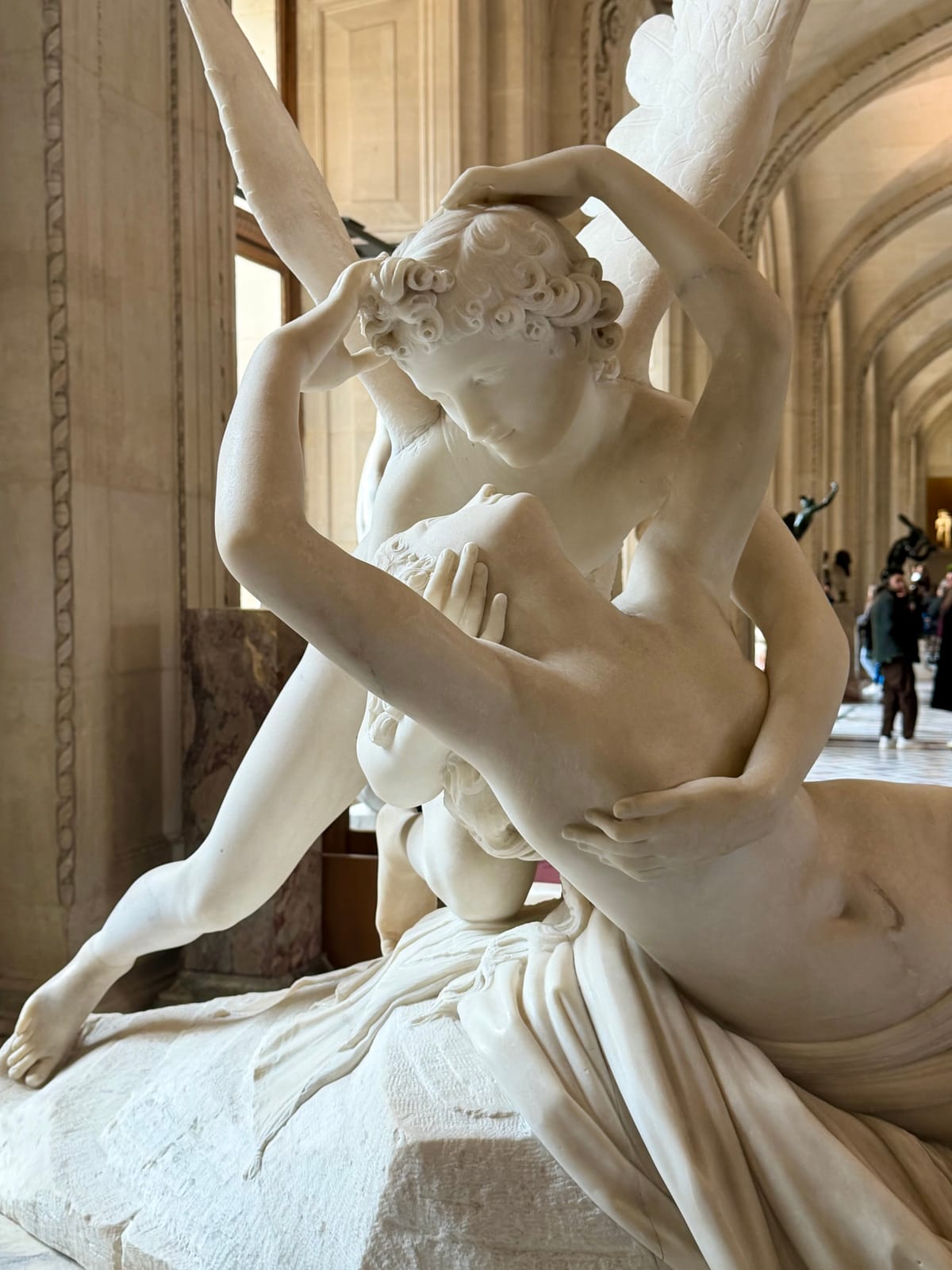
There are stories that refuse to settle, stories that hover between illumination and shadow. The myth of Psyche and Cupid is one of them. Each time I return to it, I sense not a tale about disobedience but a meditation on the limits of vision. The ancients sensed that seeing the beloved is never simple. What shines invites us, but the very act of approaching it alters what we see.
Plotinus understood this with rare clarity. In the Enneads he describes the soul as Psyche, always yearning for what exceeds it. The soul longs for the One, yet the closer it comes to its source, the more fragile vision becomes. True seeing requires transformation. To behold beauty without preparation is to collapse before it. When Psyche lifts her lamp beside the sleeping Cupid, she inverts this order. She tries to force illumination before she is remade by the ascent that makes such vision possible. Plotinus would say that her fall is metaphysical. The lamp exposes not Cupid, but her own unreadiness.
In this sense the myth reveals a structure far older than Apuleius. There is a form of light that clarifies, and a form of light that wounds. Psyche seeks the latter without first enduring the former.
🌈 II. Sainte Chapelle and the Architecture of Light
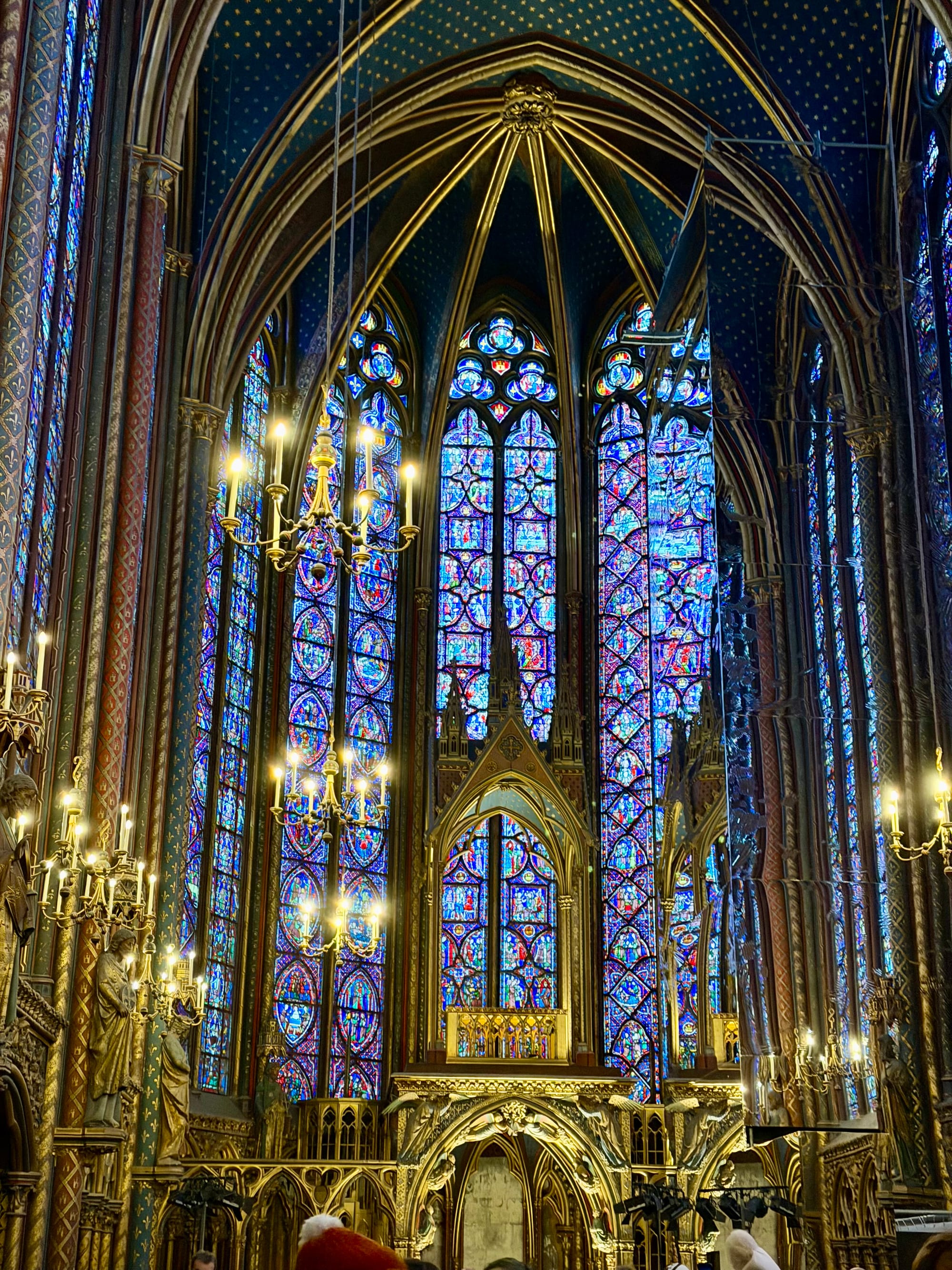
I carried this thought with me into Sainte Chapelle. The upper chapel has always felt like a world sustained by translucence rather than stone. This visit the effect was even stronger. The glass rose around me like a suspended cosmos of colour, each pane a fragment of radiance that seemed to hold the architecture in place.
It was Grosseteste who returned to me then, the medieval bishop whose De Luce imagines creation as the expansion of an initial point of light. Light, for him, is the first corporeal form. It gives the universe its dimensions by unfolding outward. Seen in this way, Sainte Chapelle is not simply Gothic splendour. It is a cosmological statement. Its walls retreat so that light may exist in its own purity. It is a structure built not from solidity, but from diffusion.
Standing there, I felt the chapel enact Grosseteste’s vision. The windows did not merely illuminate the space. They constituted it. They turned architecture into a medium through which intelligibility enters the world. The light revealed, but it also withheld. It allowed colour to bloom without ever offering the source of its own clarity. Lyotard would call this the unpresentable within the present, a beauty that gestures beyond itself.
Psyche’s lamp returned to me here. Her act was a violent illumination, a demand for presence on her own terms. Sainte Chapelle taught the opposite. It offered a revelation that arrives through patience, through a willingness to stand beneath colour without seizing it. Light was not an answer but a hospitality.
🌿 III. Water Lilies and the Numinous Drift of Memory
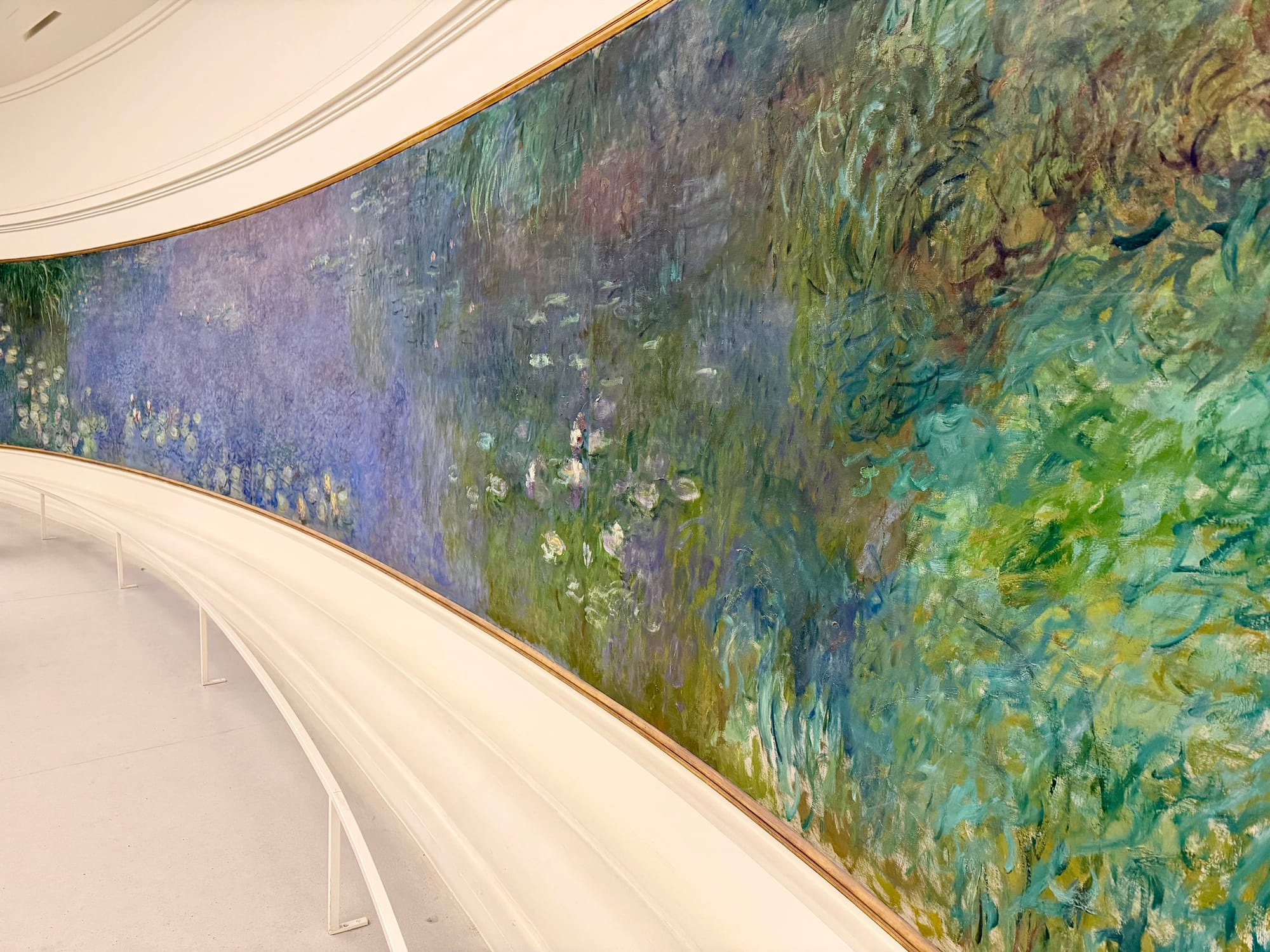
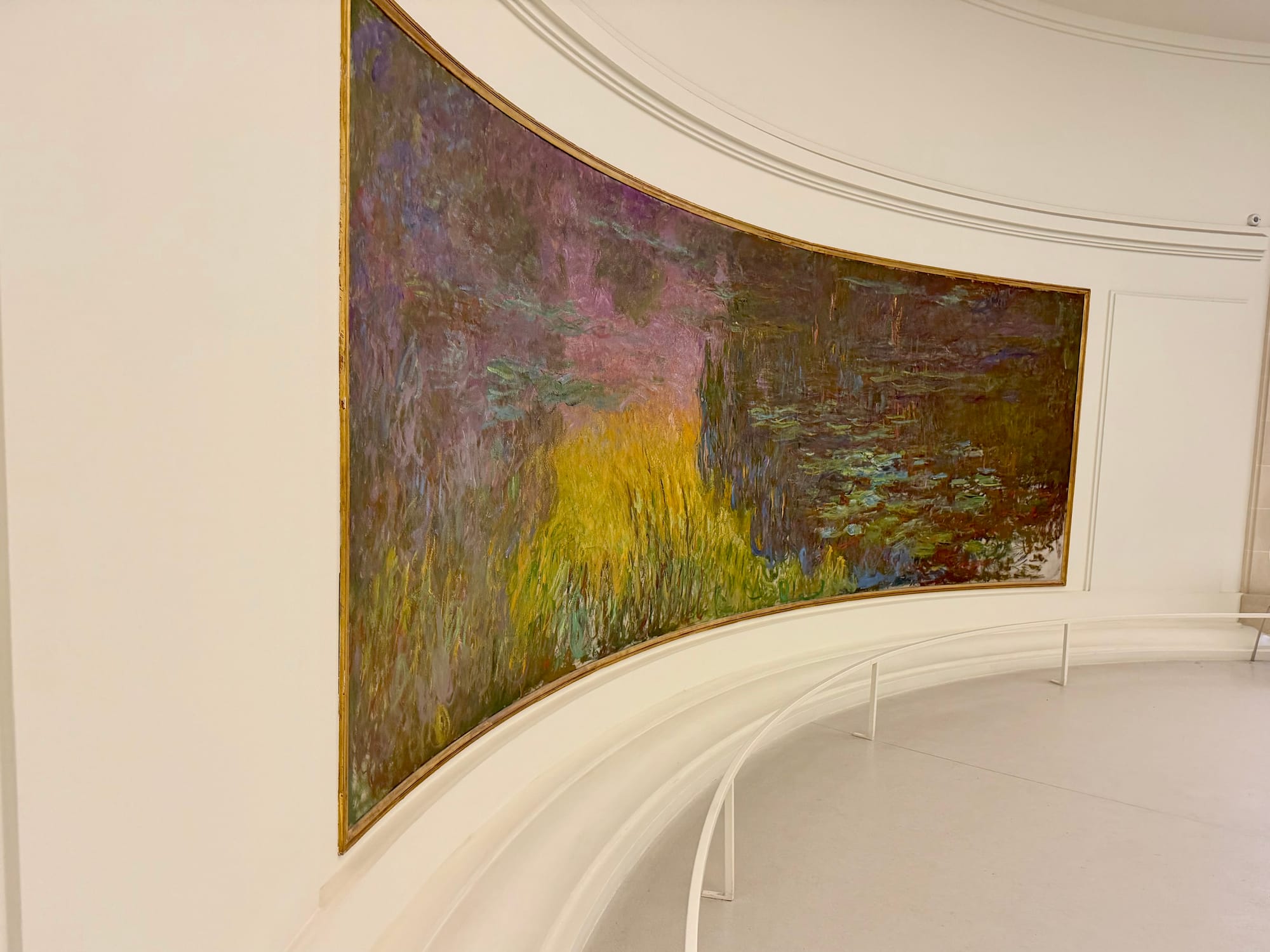
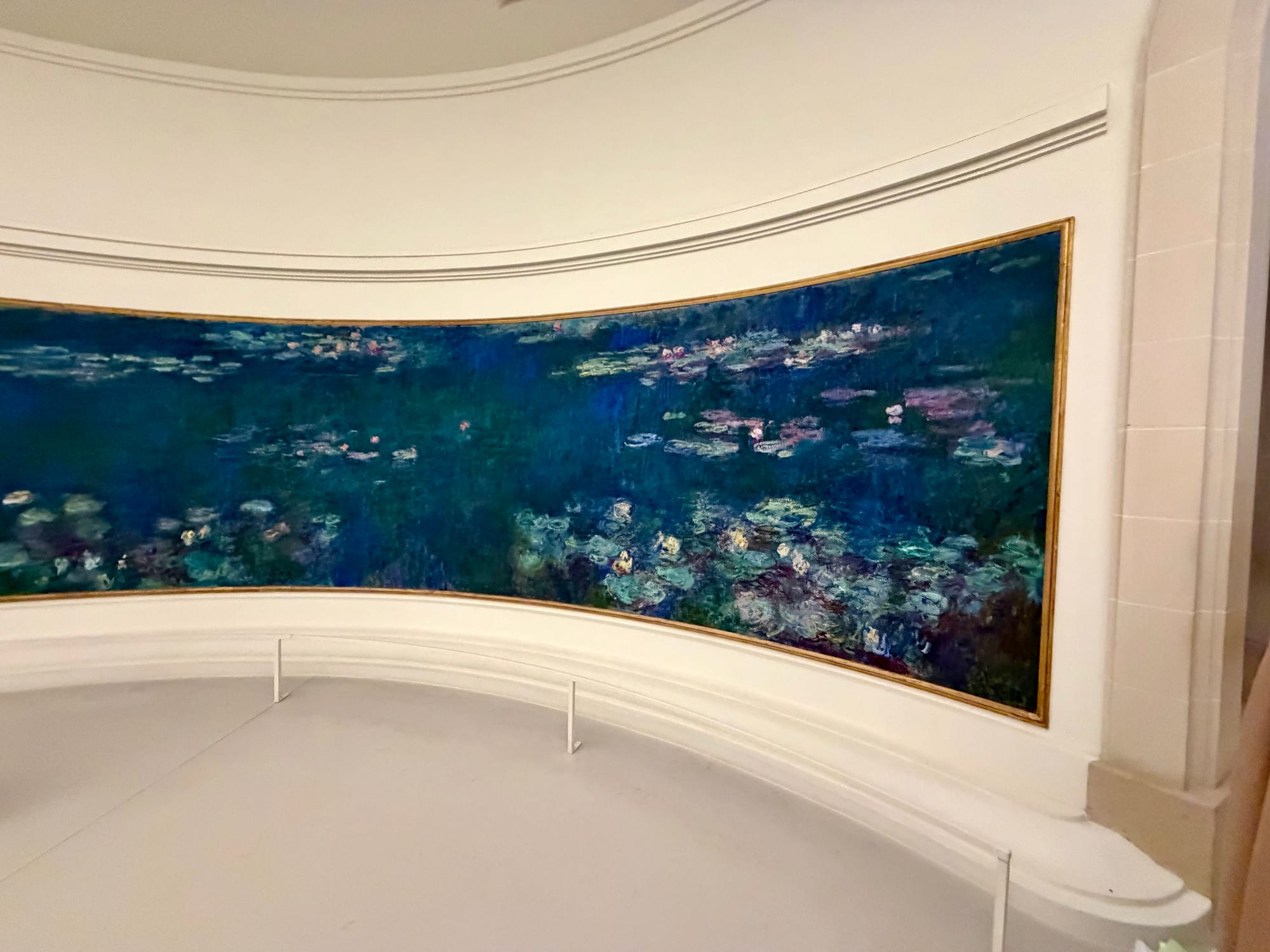
The next afternoon I found myself again at the Orangerie. I first stood before the Water Lilies at twenty four. I had left a French class at the Institut Catholique and wandered in almost at random. The rooms were quiet that day. The oval chamber felt detached from the world outside, as if time had softened its edges. I stood alone in that silence and felt something open within me. It was not simple admiration. It was a kind of numinous shock, a presence that exceeded comprehension. The panels seemed immense and tender, as if the water itself were breathing. I left with the sense that something in me had widened.
This time the encounter was different. The canvases looked smaller. The palette felt darker, edged with a shadow I had not remembered. Even the reflections seemed unsettled, as if they carried the faint tremor of a weather I could not name. It took me a moment to understand that Monet had not changed. I had. The paintings were reading the shape of my interior life.
Merleau Ponty provides a language for this. Perception, he writes, is never the neutral reception of an image. It is the intertwining of self and world. The eye participates in what it sees. My twenty four year old self moved within a more porous horizon. Wonder was natural. Now my vision carries the weight of intervening years, of desires tested, joys deepened, fears acknowledged. The lilies had shrunk because my spirit had gained density. Their once vast calm now registered the subtle turbulence of a life that has become more interior.
It was not disillusionment. It was a new register of truth. The myth returned again. Psyche believed that seeing the beloved would yield certainty. Yet vision always reveals the beholder as much as the object. My shifting perception became a quiet lesson in the fragility of sight.
💠 IV. Lewis and the Remaking of Vision
C. S. Lewis understood that the myth turns inward long before it turns outward. In Till We Have Faces he shifts the centre of gravity away from Psyche and toward Orual, whose narrative becomes a confession disguised as an indictment. Orual longs for clarity, yet her desire for truth is shaped by the wounds she refuses to acknowledge. Her devotion to Psyche is sincere, but it is also possessive. She loves intensely, yet she loves in a way that binds.
Lewis’s insight is that revelation is ethical before it is intellectual. The gods cannot meet Orual until her vision is purified, until she relinquishes her need to have her loves justified on her own terms. Psyche’s lamp exposes her unreadiness. Orual’s long complaint exposes her self-deception. When Lewis writes that we cannot meet the gods until we have faces, he names the slow work by which desire becomes capable of truth.
This reframes the myth entirely. The tragedy is not that Psyche sees too much. It is that we often see through lenses we have never examined, lenses shaped by longing, fear, or unspoken grief. Psyche’s fall is sudden. Orual’s unfolds through years. Both reveal the same principle. Vision reveals the world, but it also reveals the self that sees.
🌆 V. Afterglow on the Seine
When I left the Orangerie Paris was dissolving into evening. The Seine drifted with a metallic softness. Buildings that had been clear at noon now glimmered with the blurred promise of dusk. My reflection passed over the water in fragments. The city offered itself quietly, half revealed.
In that afterglow I realised something simple. The myth of Psyche and Cupid is not a story about forbidden sight. It is a story about the slow remaking of vision. Plotinus showed me that light without transformation fractures the soul. Grosseteste showed me that illumination is an act of creation rather than inspection. Merleau Ponty taught me that perception bears the imprint of our inner life. Lewis taught me that clarity is inseparable from humility. The Water Lilies taught me that what once felt infinite may later feel finite, yet still true. And Paris, patient as ever, taught me that revelation often arrives in the quieter registers of the day.
Perhaps this is the quiet truth behind Psyche’s story. The beloved is always encountered through a veil. The veil is not what prevents revelation. It is what prepares us for it.