🌊 The Springs Beneath the City
Cities normally begin with power.
A fortress secures a frontier.
A port commands trade.
A palace gathers authority around itself.
Bath begins elsewhere.
Beneath the limestone hills of Somerset, rainwater seeps slowly through fractures in the rock, descending deep into the earth before rising again as warm mineral springs. By the time the water returns to the surface it carries heat and dissolved minerals from the depths of geological time.
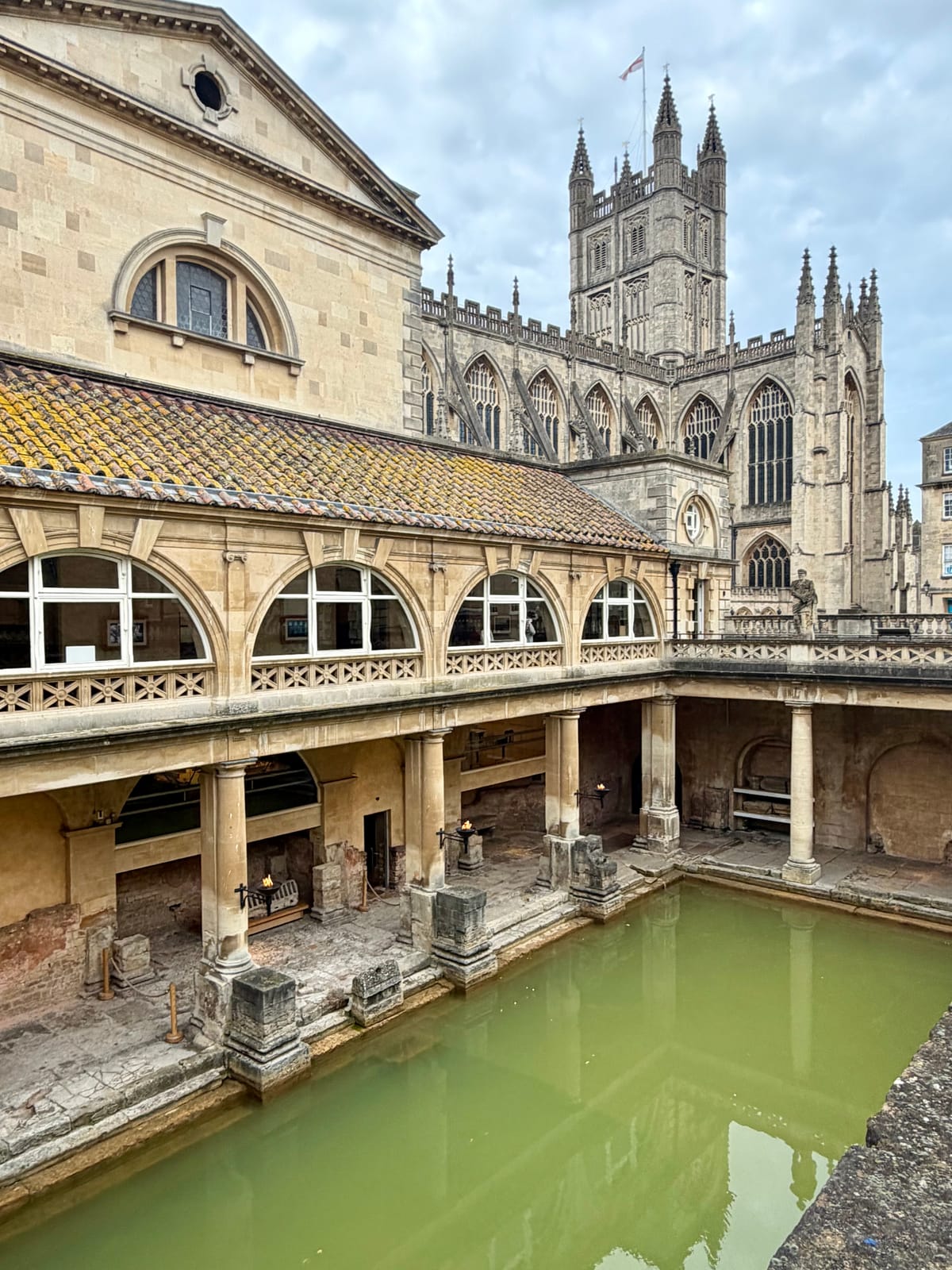
When the Romans encountered these springs they recognised their significance immediately. A temple and bathing complex were constructed here and the settlement was named Aquae Sulis.
Bath therefore began not with walls or markets, but with water.
Everything else followed.
🏺 Galen and the equilibrium of mixture
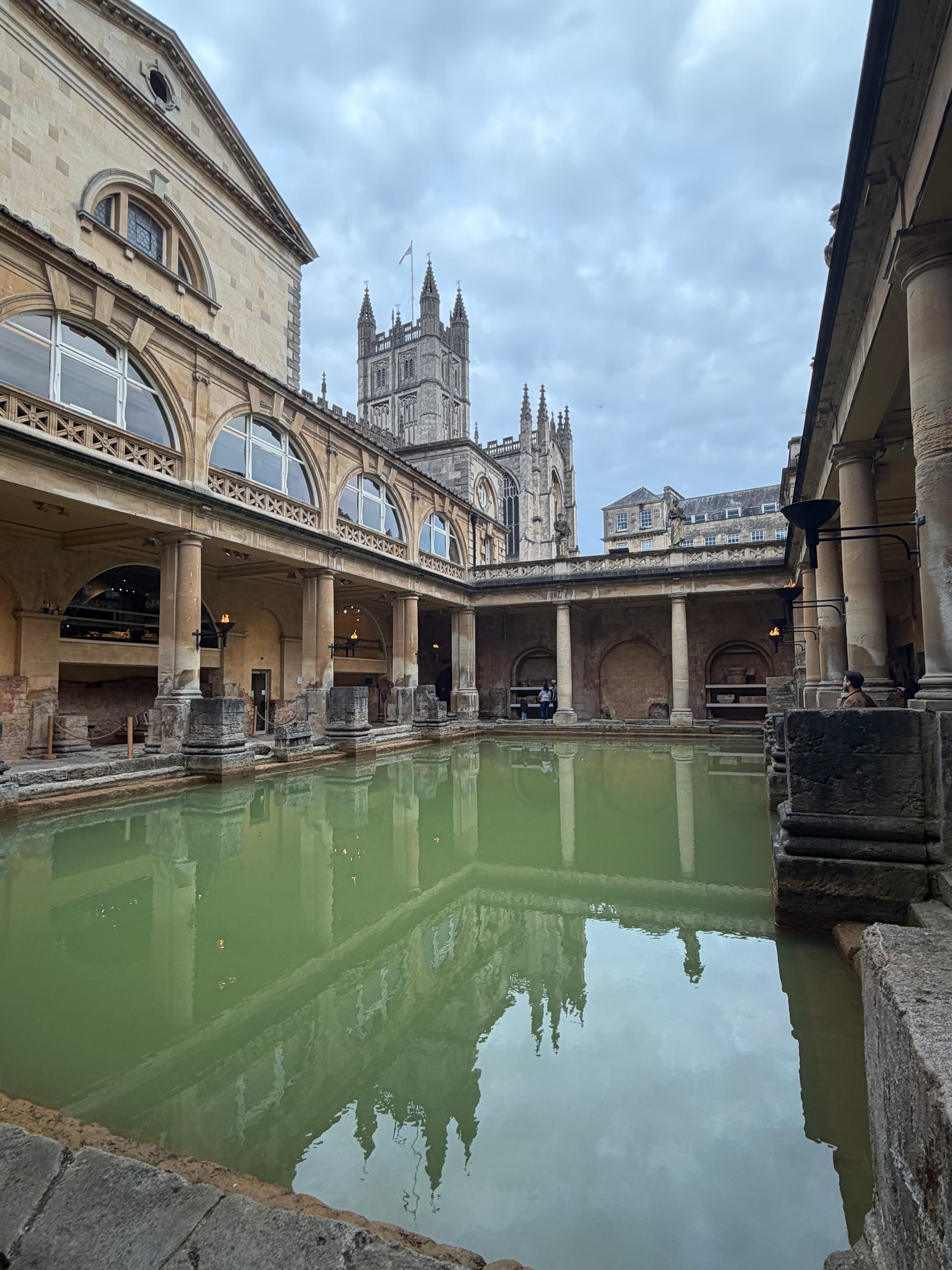
Roman medicine understood the body not as a machine but as a balance.
In De temperamentis, Galen described health as the proper mixture of elemental qualities: hot and cold, dry and moist. Every organ possessed its own temperamentum, a delicate equilibrium that sustained life. Illness appeared when that mixture drifted out of proportion.
Therapy therefore aimed not at domination but at restoration.
Bathing played an important role in this therapeutic landscape. Different waters possessed distinct thermal properties capable of influencing the body’s internal balance. Warm mineral springs were particularly valued because they restored heat and circulation gently, allowing the organism to recover its natural mixture.
The springs at Aquae Sulis therefore possessed a medical logic long before they acquired architectural grandeur.
Water rose through the limestone strata carrying warmth from the earth. Roman engineers shaped its flow into pools and chambers. The bather entered this carefully structured environment and the body’s internal krasis slowly returned to equilibrium.
The baths were therefore not merely buildings.
They were instruments designed to restore proportion to the body.
Standing beside the green water today, it becomes clear that Bath began as a city organised around the fragile equilibrium of human flesh.
🏛️ The city and the soul
Centuries later the Roman baths fell silent. Their stone structures sank gradually into ruin and the springs continued to flow beneath the earth.
Bath’s second life arrived in the eighteenth century.
Architects such as John Wood the Elder and John Wood the Younger reshaped the landscape with remarkable ambition. Limestone terraces rose across the hills in measured arcs. Squares and crescents appeared with striking regularity. The city became a composition of façades, perspectives, and carefully controlled spaces.
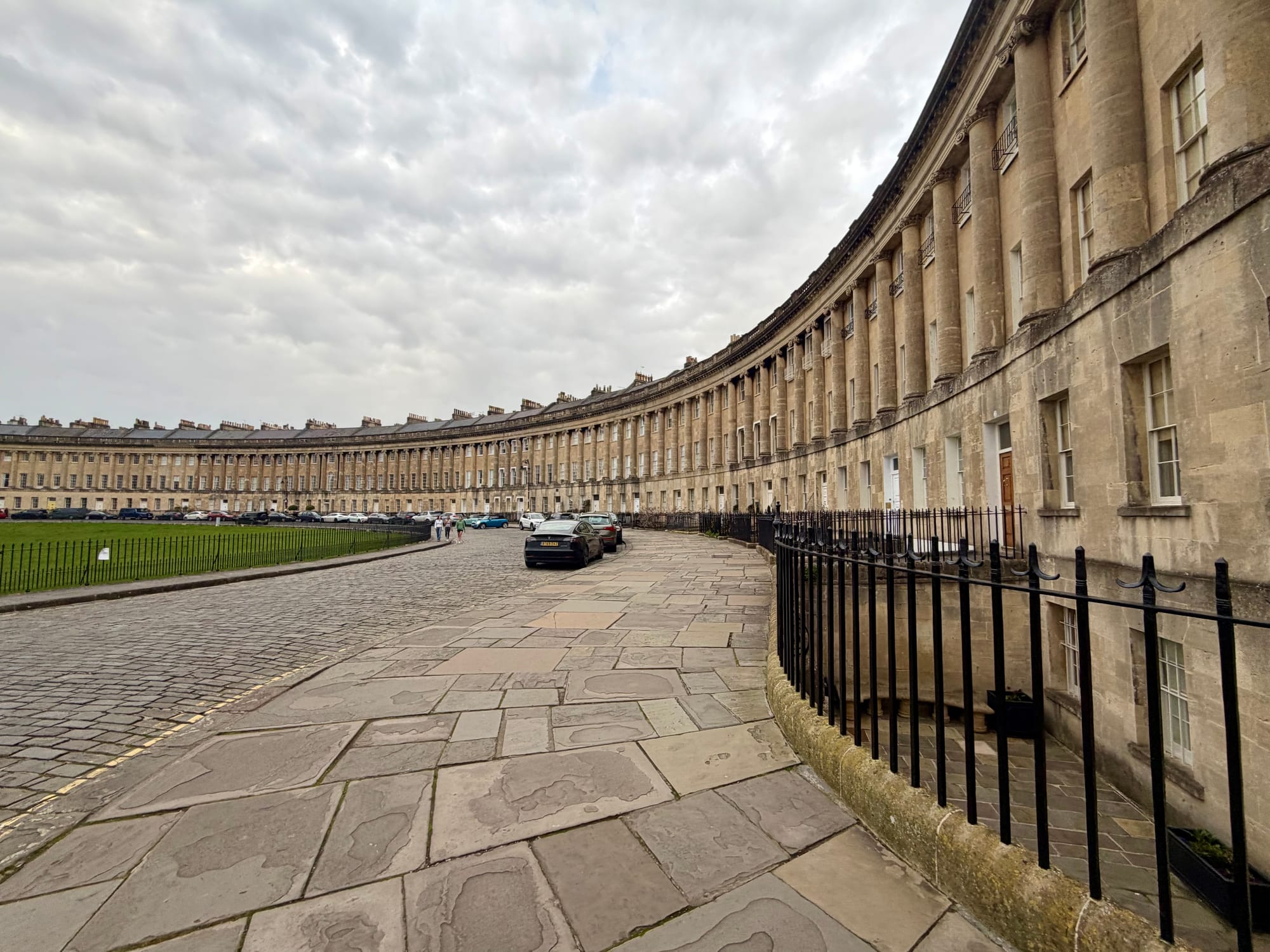
The Royal Crescent remains the most striking expression of this vision.
Its thirty houses form a sweeping arc of limestone overlooking an open lawn. Each façade repeats the same windows and columns. Individual houses remain distinct yet participate in a single architectural rhythm.
The effect is strangely philosophical.
In the Republic, Plato proposed that the structure of a just city mirrors the structure of the human soul. Justice arises, he writes, when each part performs its proper function:
τὸ τὰ αὑτοῦ πράττειν καὶ μὴ πολυπραγμονεῖν each part doing its own work and not interfering with the rest.
The analogy was meant to explain the nature of political and psychological harmony.
Walking along the Royal Crescent, the idea appears unexpectedly concrete.
Each house stands complete in itself. None overwhelms its neighbour. None intrudes upon the wider composition. Autonomy and order coexist without tension.
What Plato described philosophically begins to appear here in stone.
The city itself becomes a form of proportion.
⚖️ Leibniz and the harmony of the world
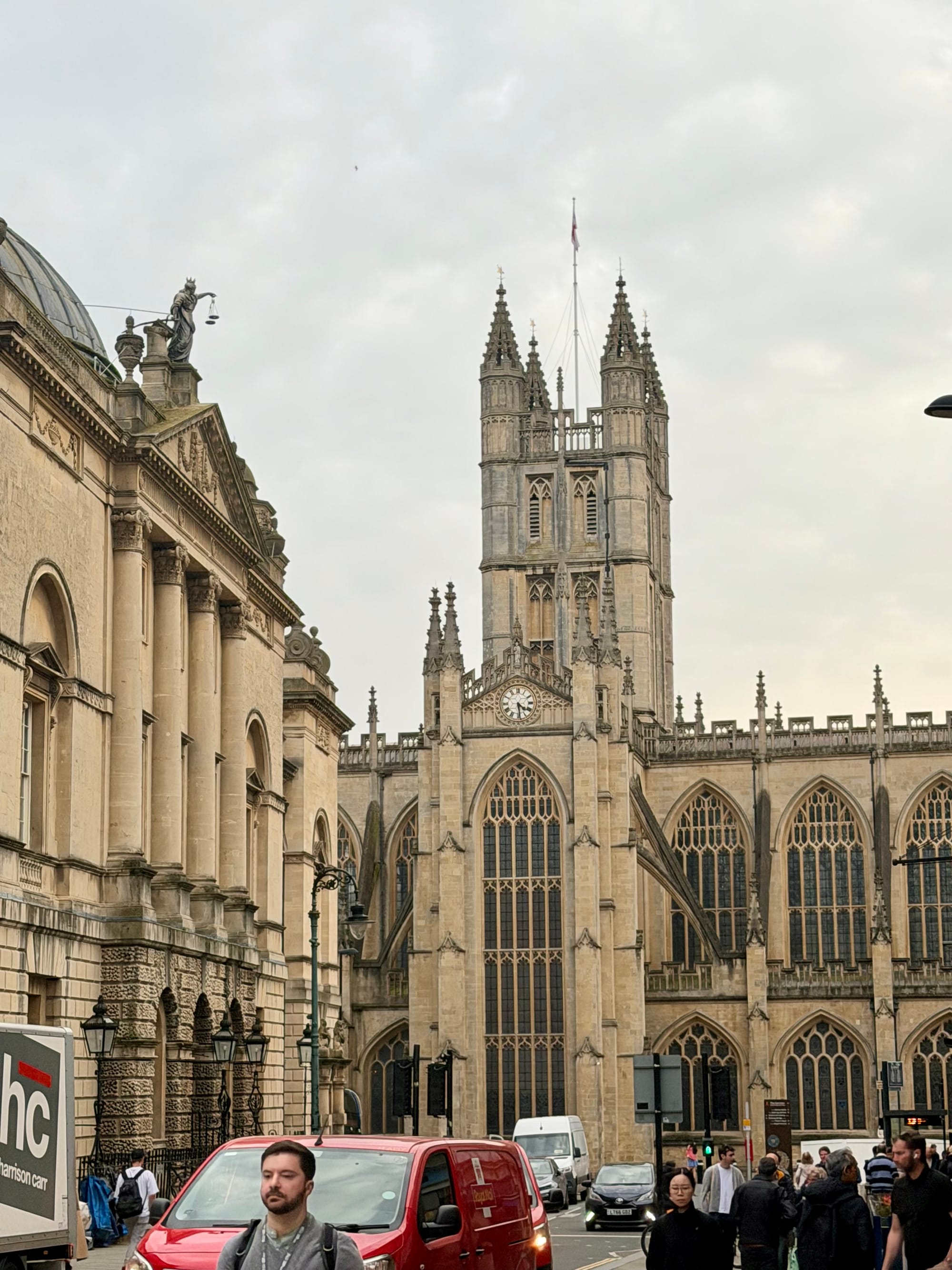
The intellectual atmosphere that produced Georgian Bath belonged to the broader Enlightenment. Within that world another thinker was reflecting on the problem of order at an even larger scale.
The philosopher Leibniz imagined the universe as a system composed of countless simple substances, which he called monads. Each monad existed independently, yet every one reflected the entire cosmos from its own perspective.
What allowed such independence to coexist with coherence was what Leibniz called pre-established harmony.
The universe remained ordered not because its parts constantly forced one another into alignment, but because a deeper structure already held them together.
Walking through Bath, the thought feels almost architectural.
Terraces repeat their façades with quiet rhythm. Streets align in carefully measured perspectives. Individual houses maintain their independence while participating in a larger composition that binds the entire city together.
The Georgian planners did not set out to illustrate Leibnizian metaphysics.
Yet their architecture seems to embody the same intuition.
Harmony emerges when independent elements participate in a deeper order.
⛪ The vertical dimension
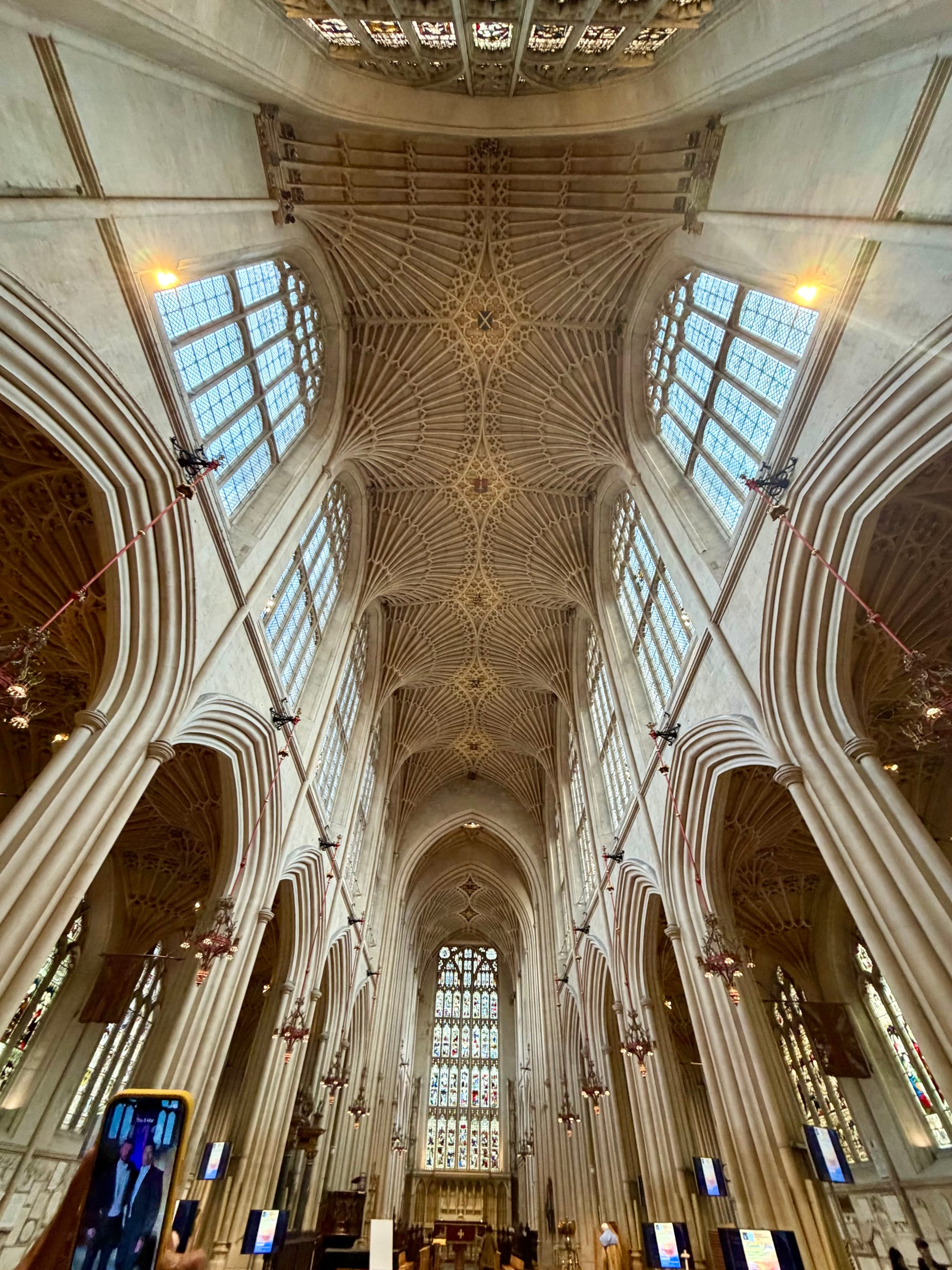
If Roman Bath concerned the body and Georgian Bath the rational city, Bath Abbey introduces another dimension.
The abbey’s fan vaulting spreads across the ceiling like an unfolding canopy of stone. Rib after rib branches outward with extraordinary delicacy, forming patterns that resemble organic structures rather than mechanical designs.
Looking upward, one senses that architecture has changed its register.
The Romans sought equilibrium in the body.
The Georgians sought harmony in the city.
The medieval builders of the abbey sought something more difficult to describe.
Their architecture directs the eye upward, suggesting that the structure of reality itself may not be merely horizontal but vertical.
Human life does not only balance and harmonise.
It also reaches.
🌉 Reflections on the Avon
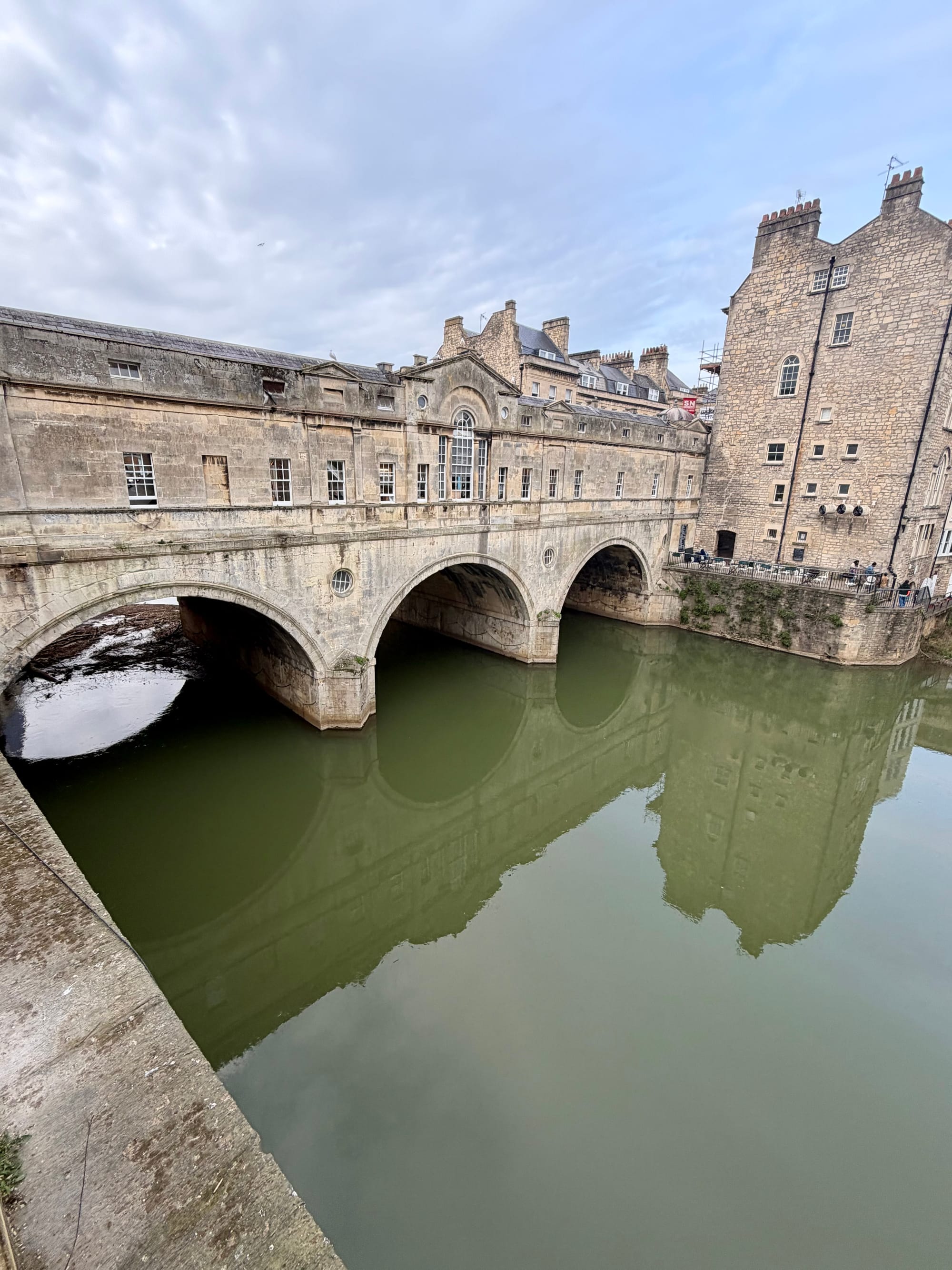
From Pulteney Bridge, the river Avon moves quietly beneath the terraces of Georgian stone.
The water reflects the façades of the city with remarkable clarity. Buildings appear doubled in the surface of the river, as though Bath itself were participating in a quiet symmetry.
Yet beneath that reflection the current never stops moving.
Water continues to rise through the limestone beneath the hills. Warm springs still fill the Roman baths. Visitors still arrive hoping, perhaps unconsciously, to restore something within themselves.
Two thousand years ago Romans came here seeking the equilibrium of the body described by Galen.
Eighteenth-century travellers arrived seeking the civic harmony imagined by Plato.
Philosophers like Leibniz imagined a similar order at the scale of the universe itself.
Bath quietly gathers all three.
Body.
City.
Cosmos.
And beneath them all, the water continues to rise.