The Silence Before Meaning: Aokigahara, Apeiron, and the Unfinished Soul
“Whereof one cannot speak, thereof one must be silent.”
— Ludwig Wittgenstein, Tractatus Logico-Philosophicus
I believe there is a silence that predates speech, and a knowing that precedes thought. In Aokigahara, I came close to both: not as metaphors, but as difficulties.
They call it the Sea of Trees. I did not go there in search of ghosts. I went because I wanted a place that would not explain itself. A place that would not flatten into story or invite my reflection. I’be spent much of the last year translating reflection into poetry, silence into insight, landscape into symbol.
Aokigahara offered none of that.
It did not mirror. It did not confront.
It simply withheld.
And in that withholding, something stirred.
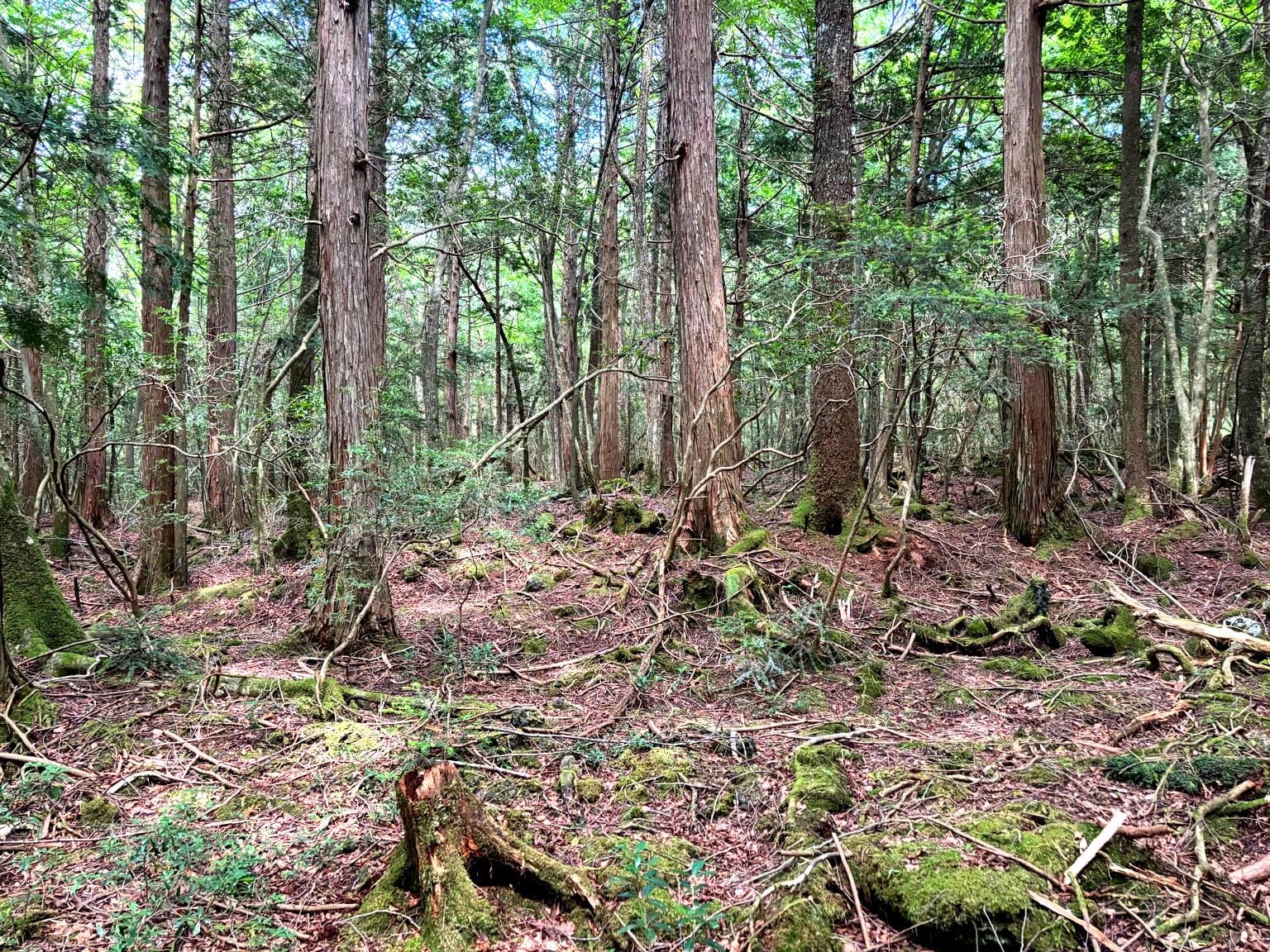
🈳 Ma, Diastēma, and the Shape of Absence
Before the forest gave me silence, it gave me pause.
The Japanese aesthetic principle of ma, the space between, the pause that structures presence, was not new to me. I had written about it before, from temples and tea rooms, from stages and stones. But ma in Aokigahara was not architectural or composed. It was ambient refusal.
The forest does not say, “Wait.” It simply does not proceed.
Ma here is not the serenity of minimalism. It is the shape of indeterminacy. It resists completion. And that resistance recalled another kind of interval: diastēma, the metaphysical distance between creature and Creator.
In early Christian theology, especially among the Greeks, this distance was the sign of our finitude. To be human was not simply to be imperfect, but to be apart. The soul stretches toward the divine and is never finished stretching.
But what if absence is not lack? What if the gap is the form?
🌊 Apeiron, Plato, and the Shape of the Unbounded
Anaximander gave us the word apeiron: the unbounded, the indefinite. He used it to name the origin of all things. But it was not a comforting word. What has no edge cannot be held. And what cannot be held cannot be made safe.
Plato, wary of chaos, sought a grammar for the cosmos. He paired apeiron with peras: the limitless and the limiting, flux and form. Their mingling, he said, gives rise to the world. Not purity, but proportion.
Plotinus went further still. The apeiron became divine excess. The One is infinite not because it lacks, but because it overflows. It is beyond being, beyond knowing and in that very beyondness, it draws us upward. To move toward the infinite is not to grasp it, but to be shaped by the reaching.
This is no longer fear. This is metaphysical longing. A theology of ascent.
But the forest does not ascend.
📜 Gregory of Nyssa and the Holiness of Hunger
Gregory of Nyssa, drawing on that Neoplatonic inheritance, transformed it. For him, the soul’s union with God is not found in arrival, but in endless approach. He called this epektasis: the soul’s perpetual growth into the good.
“The soul’s true satisfaction,” he writes, “lies in its perpetual growth in the good.”
No stasis. No completion. Only desire made holy.
I have loved that idea. It dignifies the ache. It makes sense of the gaps. But something in Aokigahara made me uneasy with ascent. I could not reconcile this slow, padded forest with a soul climbing joyfully toward the infinite.
Because some souls stop climbing here.
🌋 Where the Climbing Stops
Aokigahara is not just quiet. It is terminal. A place where footsteps cease. Where movement: physical, spiritual, narrative, halts.
I do not say this lightly. The forest is known for its suicides. But it does not publicise them. Nor will I. What matters is the ethical gravity that enters the silence when we acknowledge that silence can be chosen.
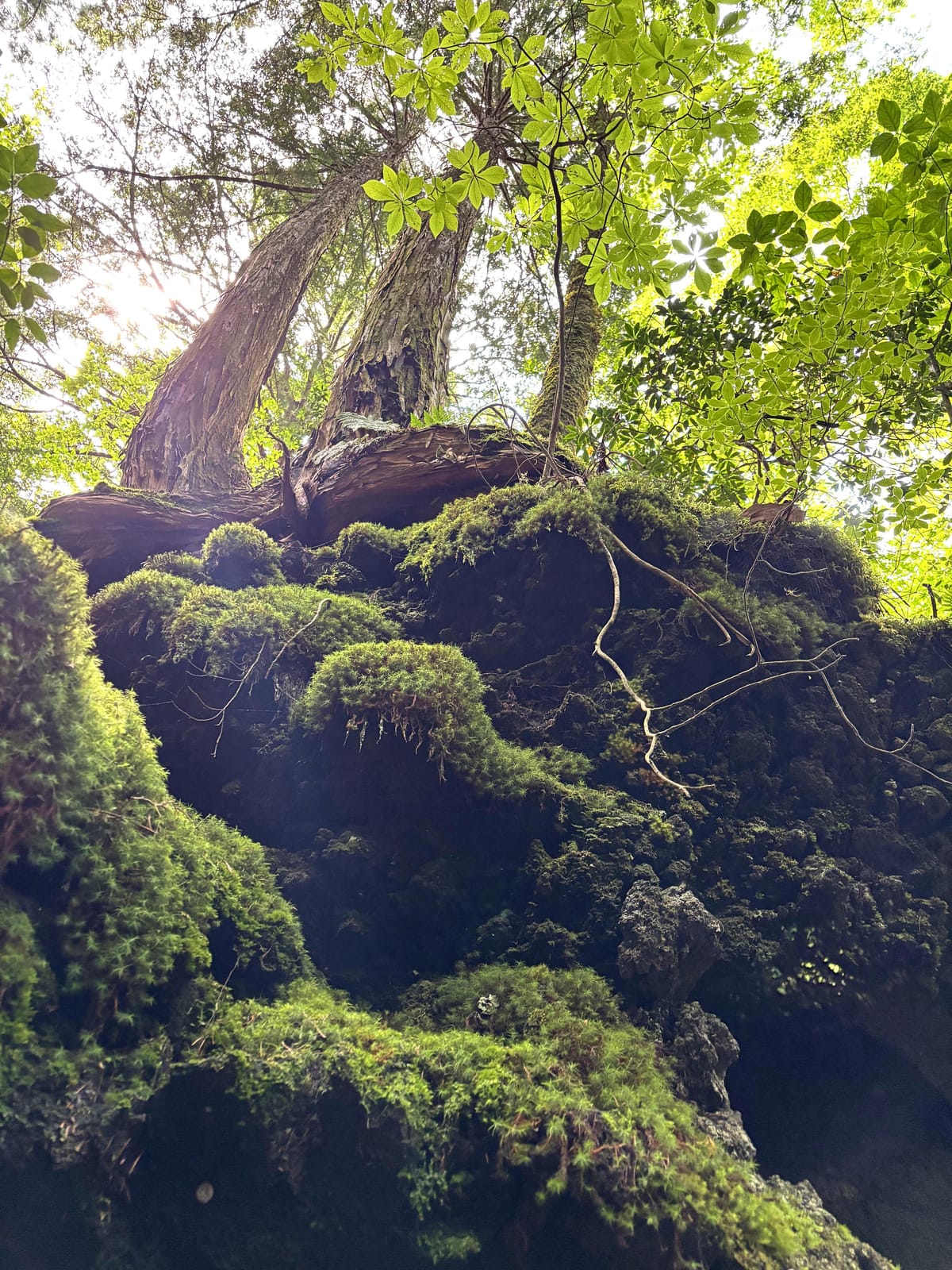
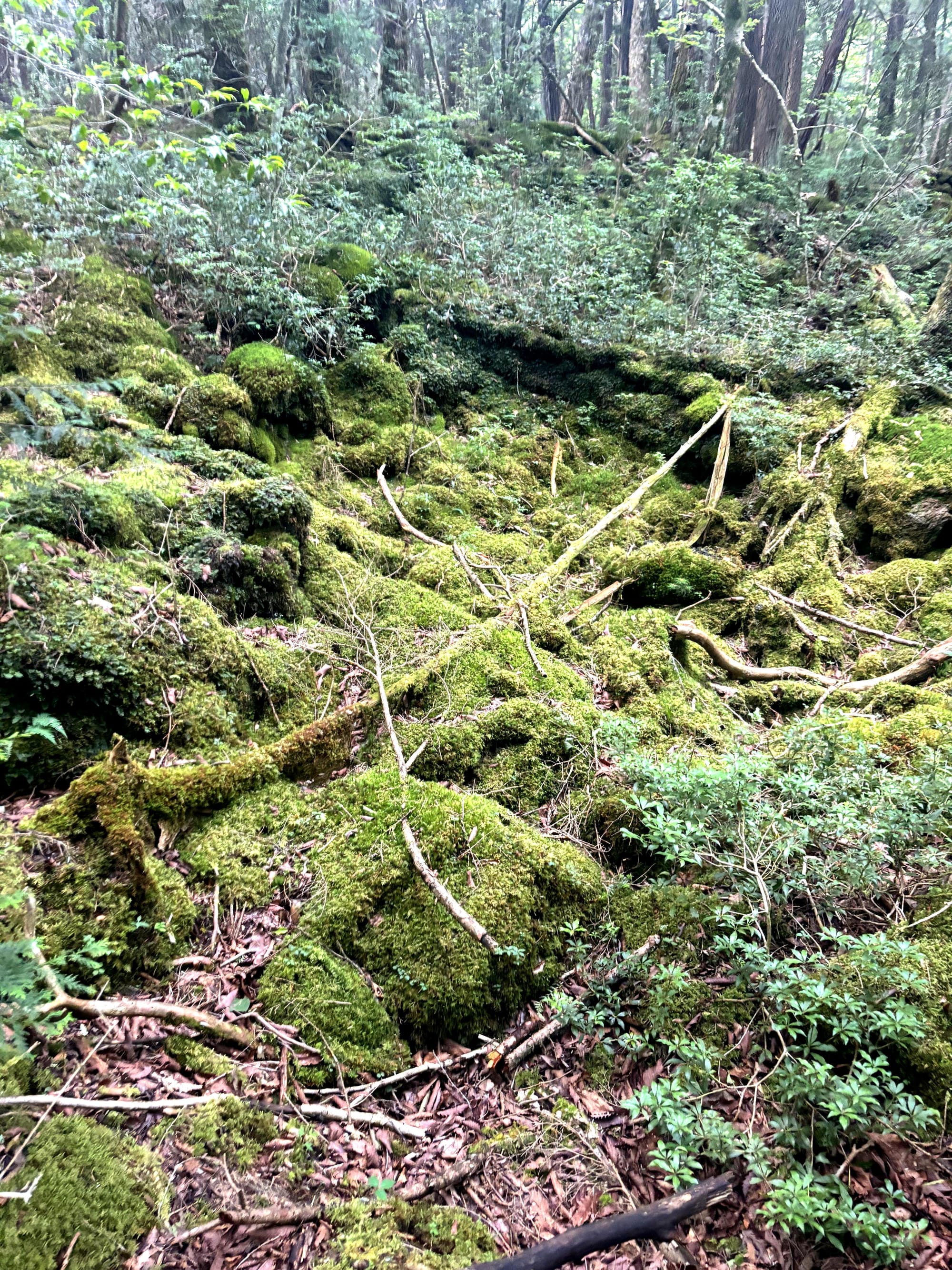
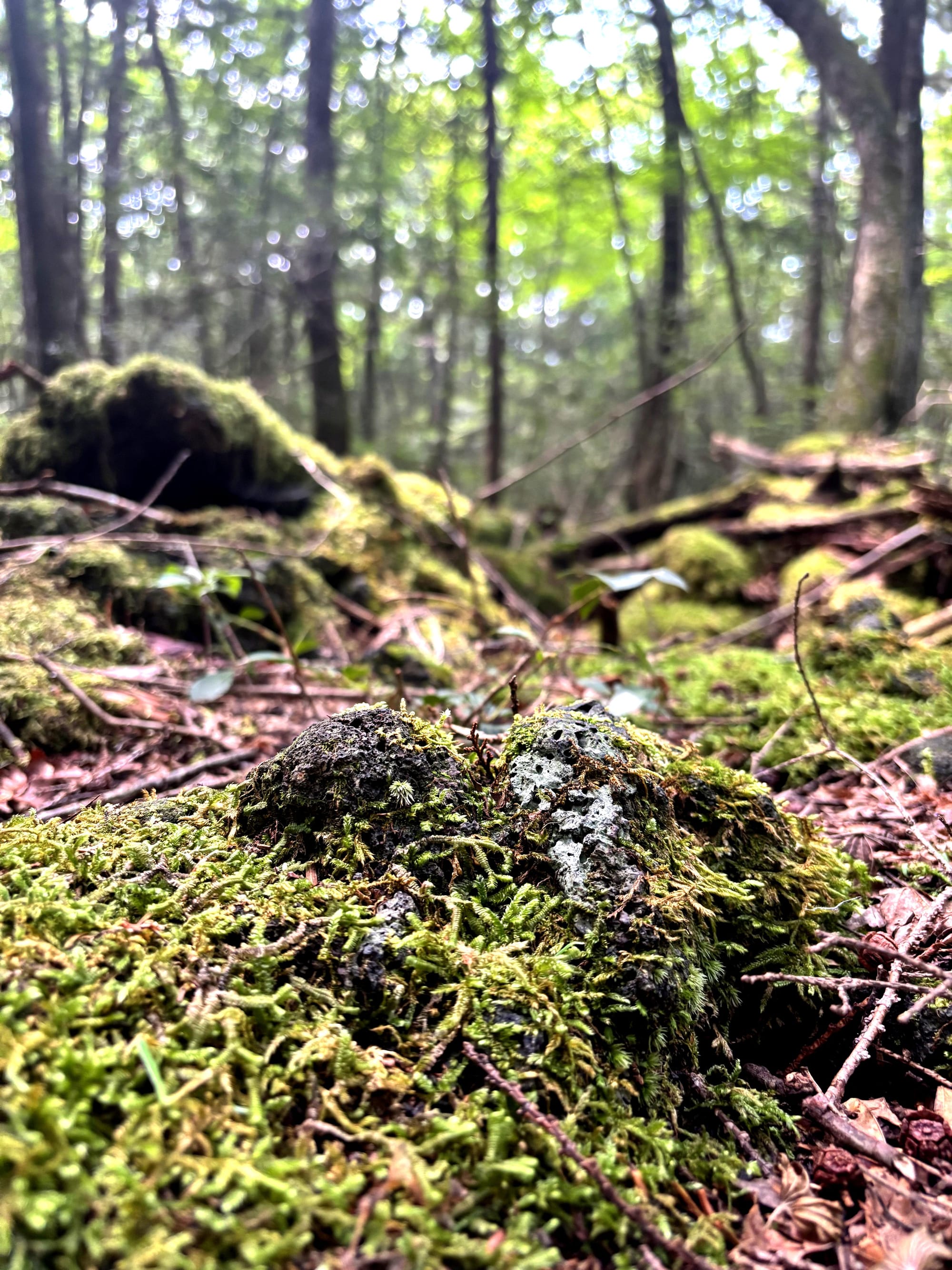
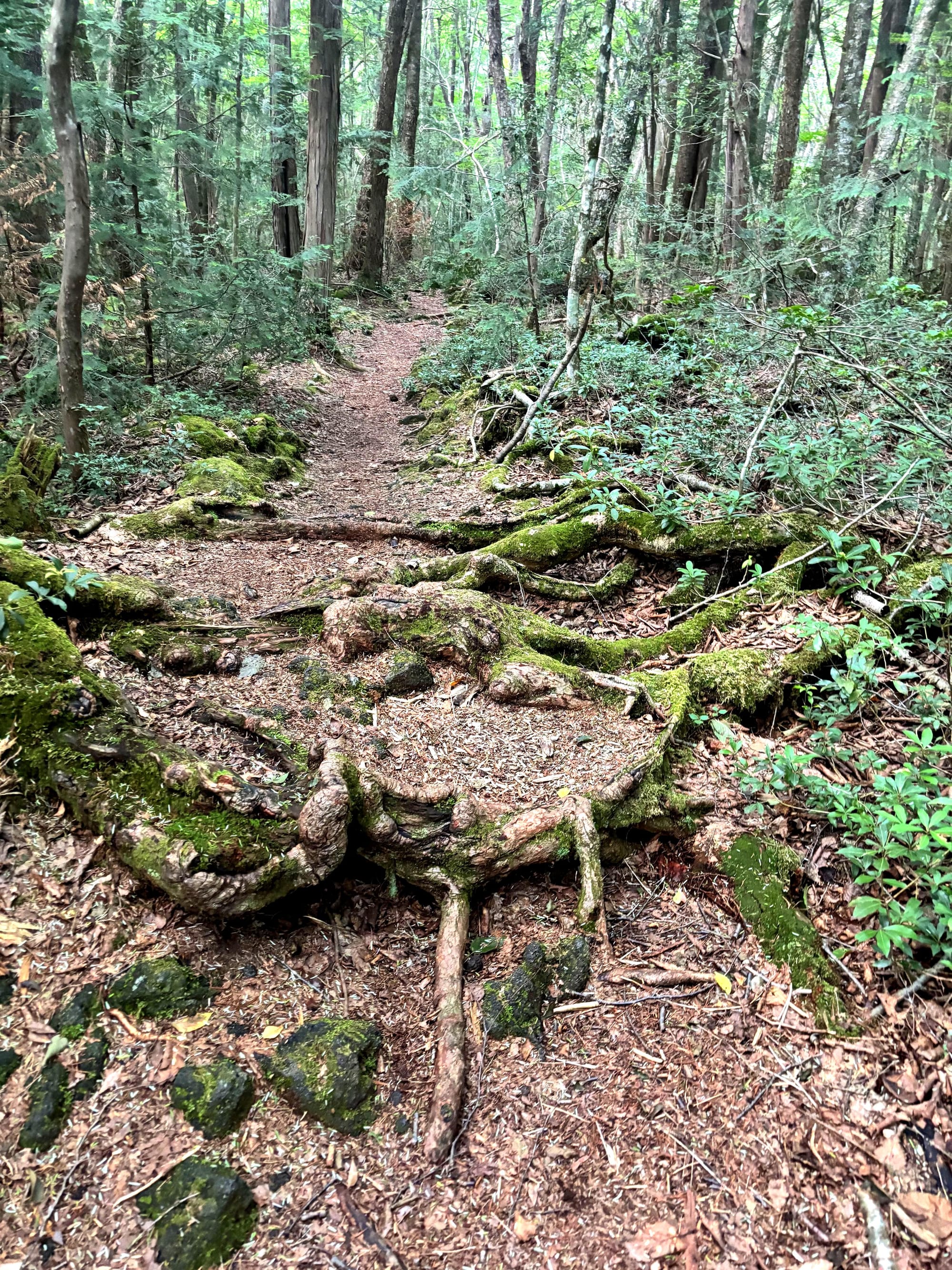
The ground beneath is volcanic: the cooled flow of Fuji’s old eruption. It is porous, sharp, unsettled. It does not elevate. It spreads. It absorbs.
And over it: moss.
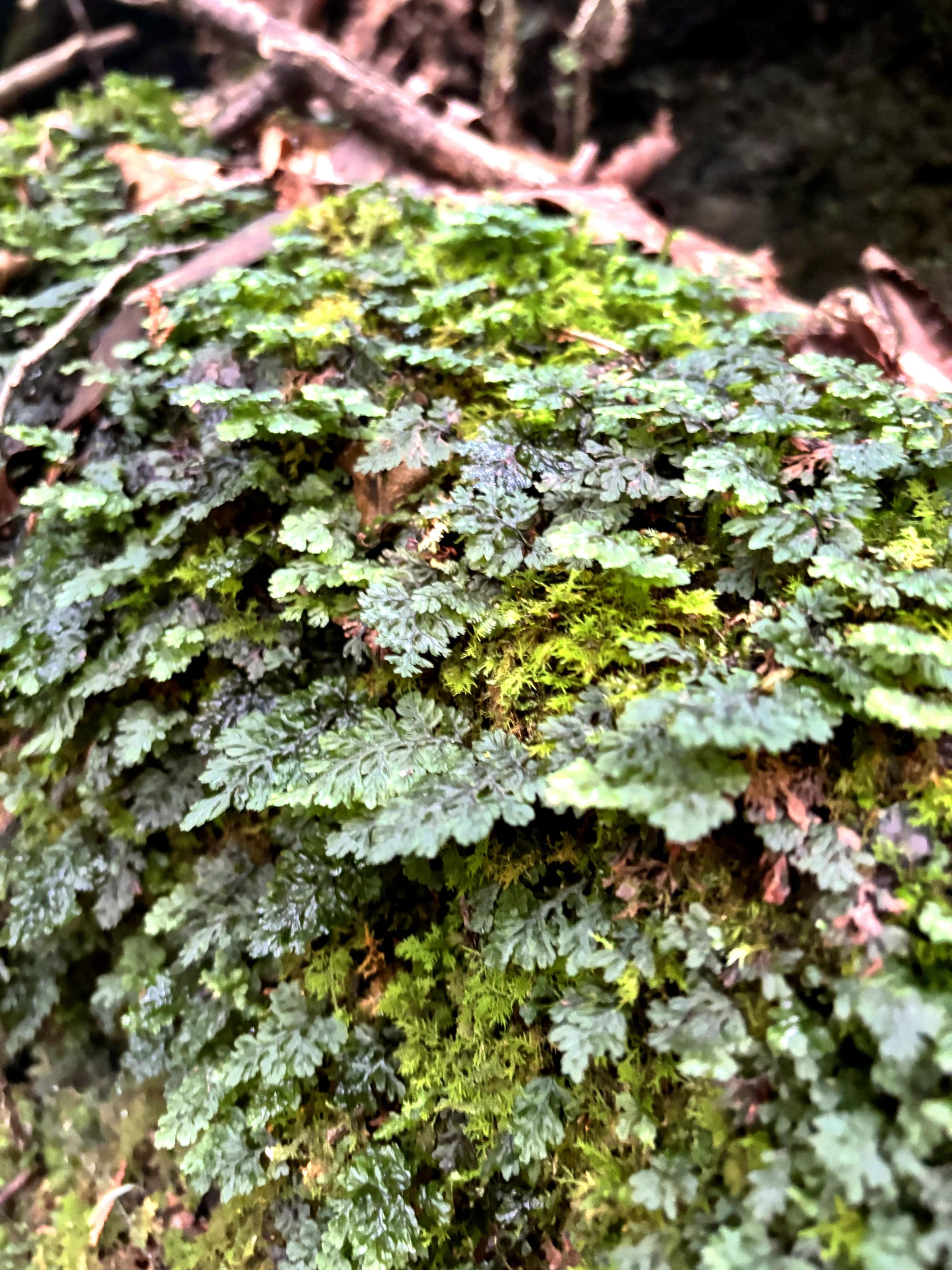
A green hush. A softening that deceives. It covers, but it does not cushion. I walked carefully, not out of reverence, but because I did not trust the earth beneath me. A stone clicked under my heel. It startled me. It made a sound that did not echo. Just landed.
Final.
I thought for a moment I should interpret it that sound, that moss, that softness. I should find the metaphor.
And then I stopped myself.
🌲 Moss, Slippage, and the Refusal of Symbol
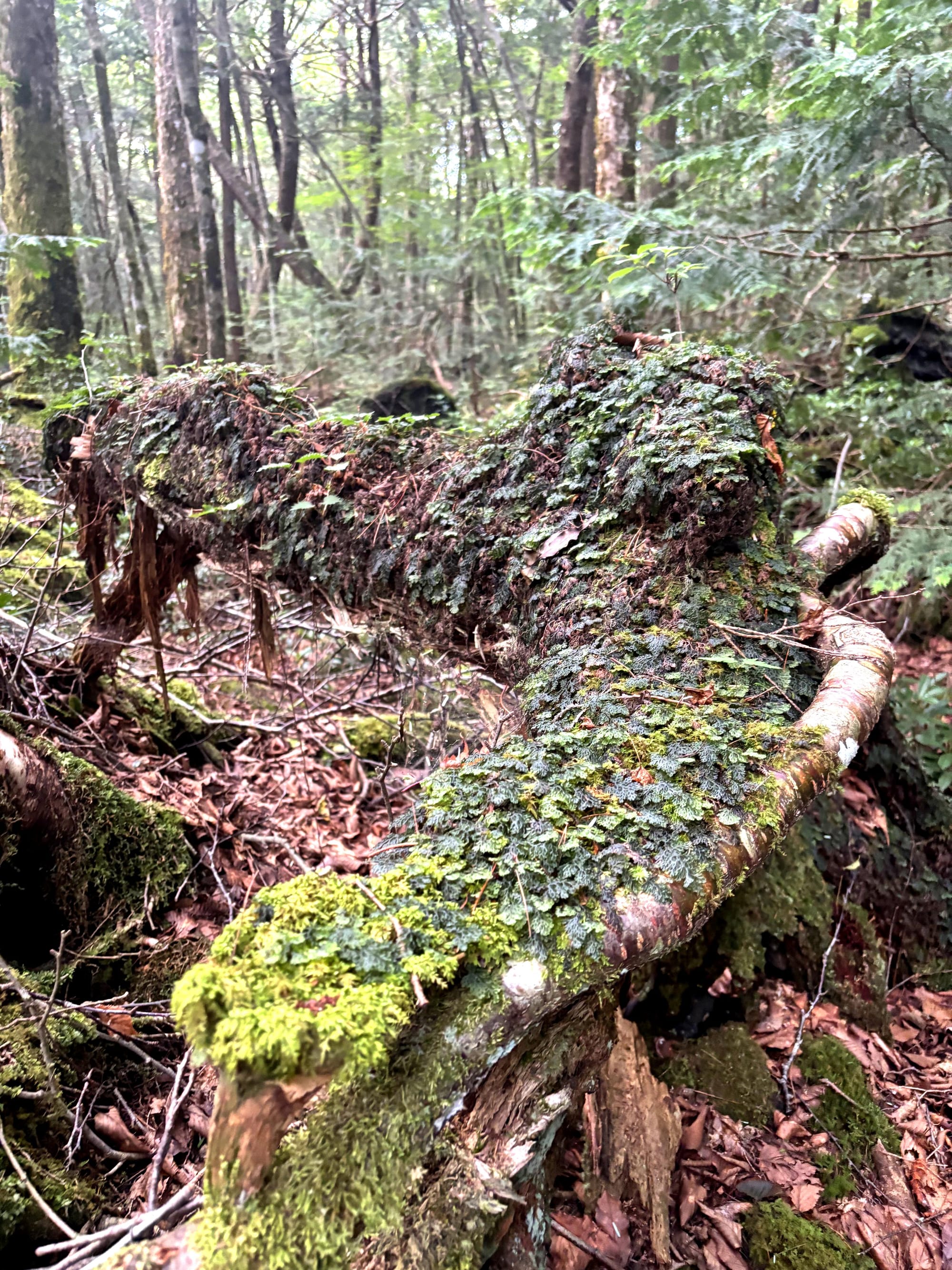
The photos say otherwise. But the moss was not soft.
It shifted. It gave way. It looked like it would hold me, and it did not.
The air smelled green. Not fresh; rotting. Humid. It was not the smell of death. It was the smell of things still dying. Life becoming softness. Softness turning to mould.
This was not mystery. This was matter.
Not metaphor, but moss.
Not transcendence, but texture.
And in that moment, the forest refused me again; not in cruelty, but in indifference. It did not yield to narrative. It did not become symbol. It remained other.
🕯 The Ethics of Aesthetic Silence
I believe in reverence. I believe there are things we should not name too quickly. But I also know that mystery can be used to avoid reality. That the sacred can become a curtain.
When I say something is “unspeakable,” am I honouring it or protecting myself?
Aokigahara is not a riddle. It is not darkness as metaphor. It is not symbolic silence. It is just dark. A place of foliage, of lava rock, of rot: and of decisions we cannot interpret.
I arrived with language. But the forest did not accept it.
And that is not its failure.
🧭 Writing as Risk, and as Witness
To write about silence is to break it. I know that. I have done that here.
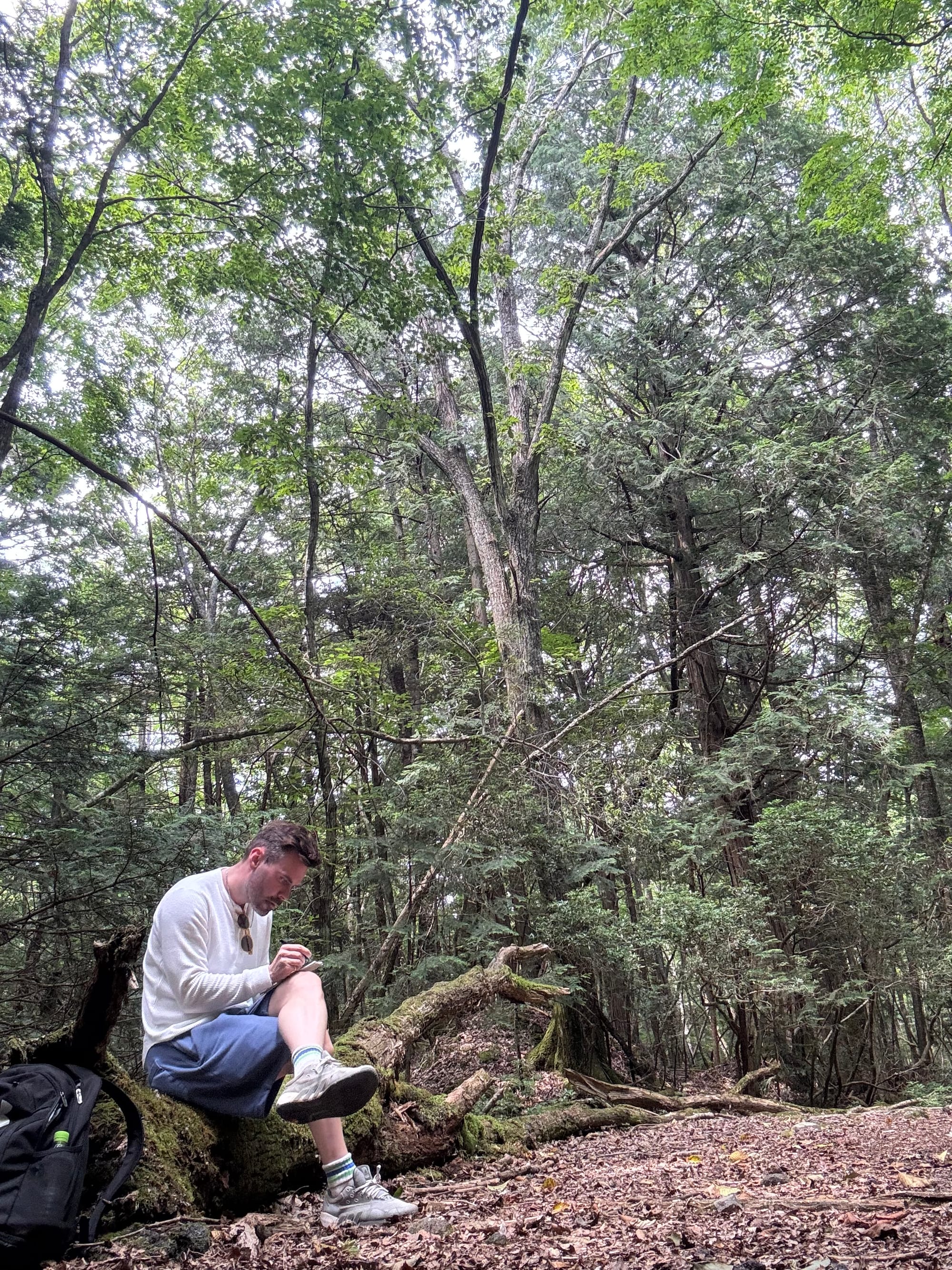
But writing, too, is how I wait. How I stay. How I mark the fact that I was here, and that I did not understand. That I do not understand now. But I stayed long enough to notice what resisted me.
I do not believe this piece redeems the forest. I do not believe language always should.
But I do believe that to write, carefully, without possession, can be a form of presence. Of being near, without explanation. Of saying: I did not climb. I did not interpret. But I remained.
🌌 A Final Question
If silence offers no answer, can I learn not to speak in its place?
And if I cannot resist reaching, if the desire to interpret is part of who I am, can I at least let the reaching remain unanswered?
That may be all the soul is meant to do.