👼📚 The Angel and the Archive: Assmann in the St Gallen Library
Part I — The Theory of Cultural Memory Beyond text
Reception studies have long been concerned with texts: how they are read, cited, reworked, inherited. Yet Jan Assmann insists that memory is not only textual. It is institutional, spatial, material. Cultural memory depends on the external supports that societies create to preserve themselves beyond the horizon of living recollection. Without these supports, texts fade back into the silence of oblivion.
Communicative and cultural memory
Assmann famously distinguishes between two forms of memory.
- Communicative memory is fragile: the stories we inherit from parents and grandparents, the living recollection that lasts only three or four generations before disappearing.
- Cultural memory endures. It is mediated through writing, monuments, rituals, images, and institutions. It is this form of memory that stabilises cultural identity, enabling continuity across centuries.
Cultural memory is not neutral. It is a canon, a selective process of remembrance and forgetting. Assmann reminds us that what survives is not simply what was written, but what communities chose to preserve, copy, institutionalise. Memory is always already interpretation.
Figures of memory
Central to Assmann’s theory are Erinnerungsfiguren, “figures of memory.” These are the monuments, images, texts, and spaces that anchor collective remembrance. They do not simply preserve the past; they shape how it is received. To read a manuscript is never only to engage with words. It is to engage with the architecture, the rituals, and the figures that frame it. A library, in this sense, is not a neutral container but a theatre of reception: a stage upon which cultural memory is performed.
Sites of memory
Pierre Nora described lieux de mémoire as the sites where memory condenses and endures: archives, museums, monuments, anniversaries. They are the institutional crystallisations of cultural will. St Gallen is such a site. It is not only a collection of manuscripts but a space in which memory has been cultivated, curated, and staged for more than a millennium. To think with Assmann is to recognise that reception takes place: and that place itself is an active participant in what we inherit.
Part II — St Gallen as a Case Study
The Abbey Library
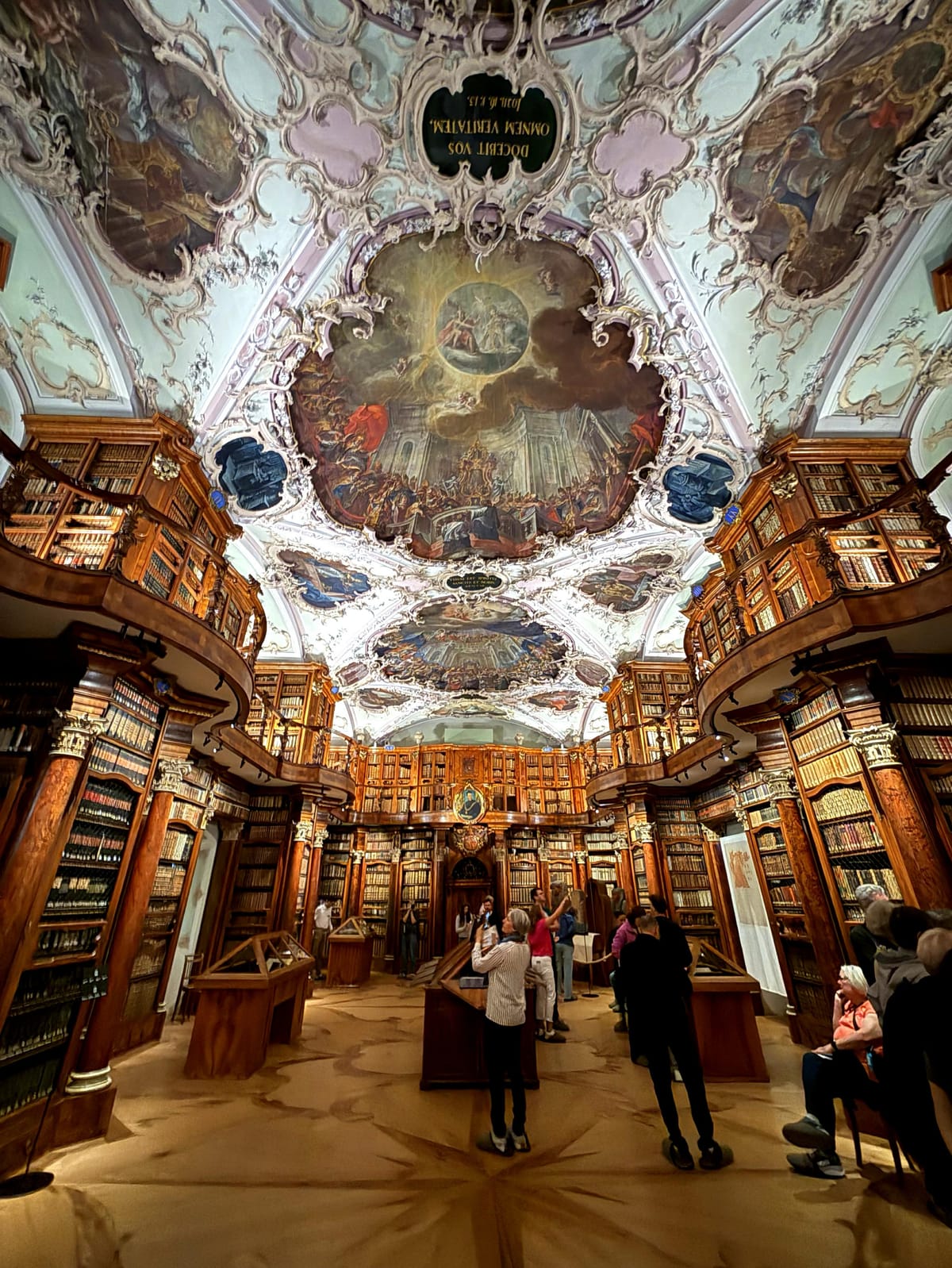
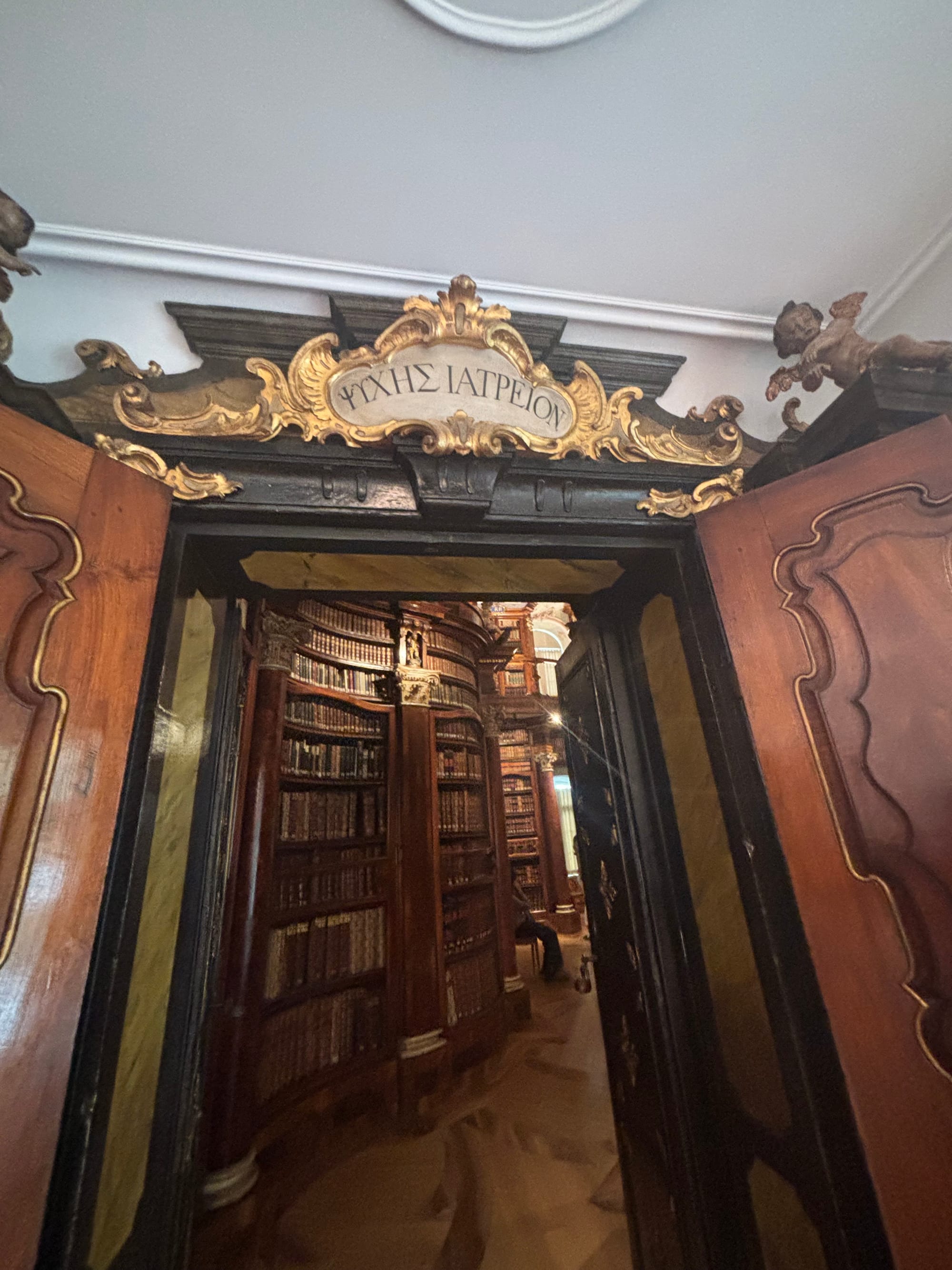
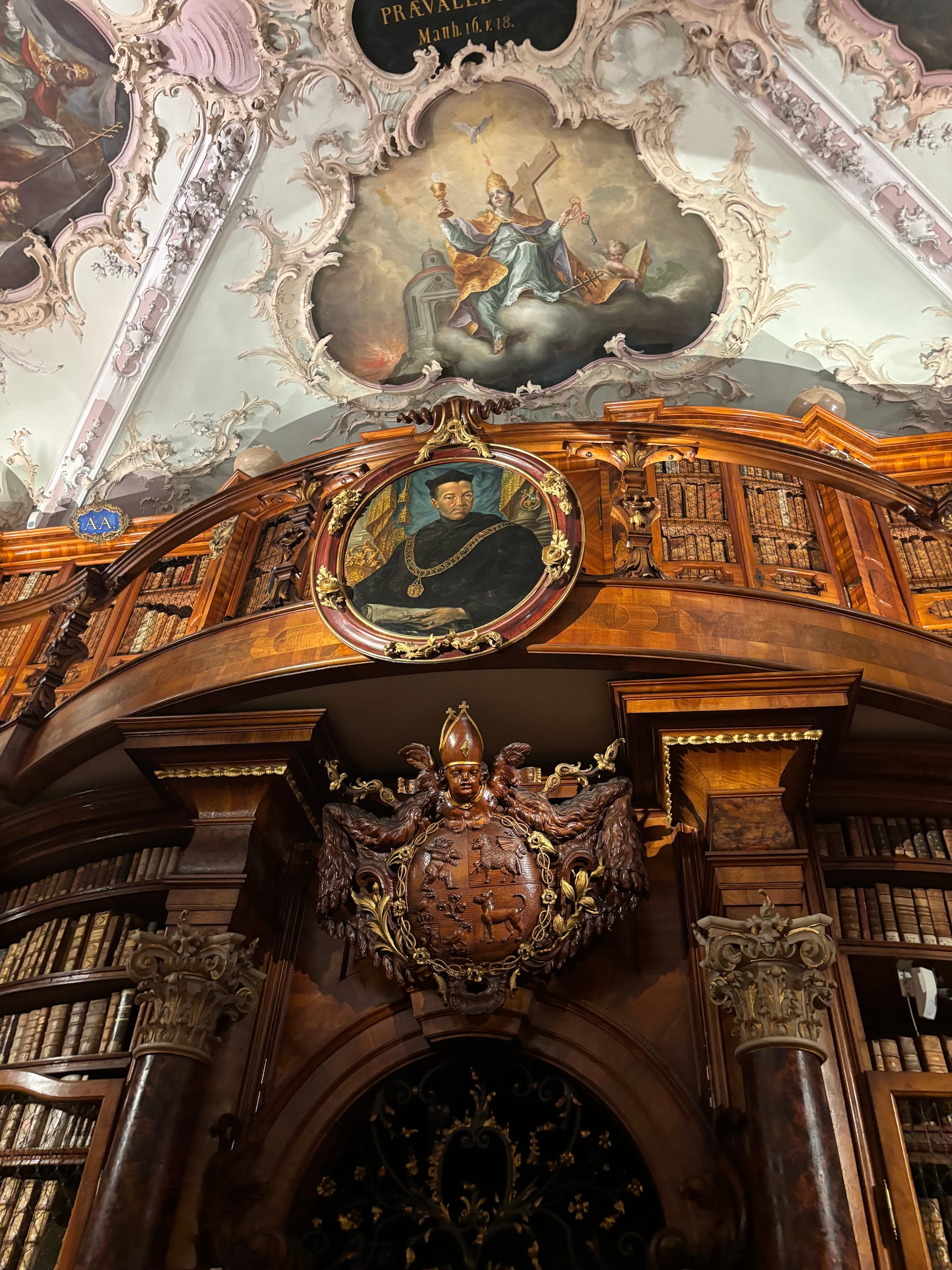
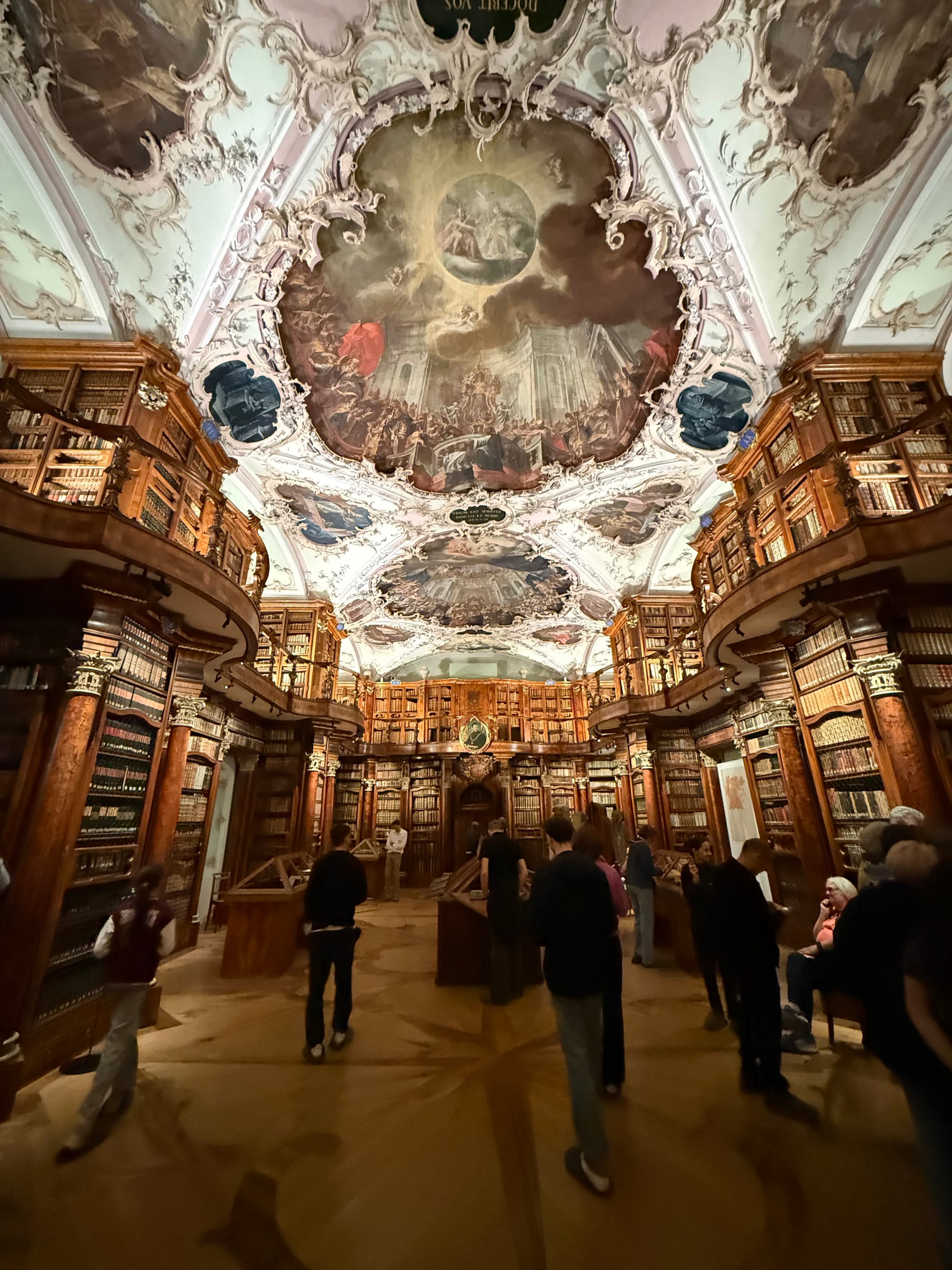
The Abbey Library of St Gallen, founded in the Carolingian age, is one of Europe’s oldest. Its manuscripts are famous, but it is the room itself that embodies Assmann’s theory. The carved wood galleries, the baroque ornamentation, the frescoed ceilings: all conspire to ritualise the act of reading. To step into the library is to encounter cultural memory staged as architecture. The institution does not merely preserve; it interprets.
Augustine and the angel
One of the ceiling frescoes shows Augustine on the seashore, confronted by an angel in the form of a child, pouring water into a hole in the sand. The scene is a parable of limits: the impossibility of containing divine mystery within finite reason. Placed above the shelves, it becomes an emblem of cultural memory itself. No library, however vast, can contain the ocean of the past. What it offers instead are fragments, framed and ritualised by architecture. The fresco reminds every reader that reception is bounded, shaped not only by what is preserved but by what cannot be.
The library as theatre
Mary Carruthers described memory as a theatre, a space in which recollection is staged. In St Gallen, the metaphor is literal. The manuscripts are received not in abstraction but under fresco, wood, and light. The library is a stage where cultural memory is embodied in ritualised silence and architectural form. To read here is to inherit not only a text but the centuries of curation and framing that sustain it.
The cultural will to remember
Assmann is clear: cultural memory is normative. It depends on the will of a community to preserve and transmit. St Gallen is a monument to that will. Every catalogue, every act of conservation, every fresco that frames the books is a declaration that memory must endure. The library is not simply a passive archive but an argument: that knowledge is worth preserving, that memory requires place, that interpretation is conditioned by the architectures we create to carry it.
Within limits
The fresco of Augustine and the angel crystallises the paradox at the heart of cultural memory. Preservation is always partial. Reception is always framed. To inherit a text is to inherit the architecture that contains it, the figures that interpret it, and the limits that remind us of what cannot be received. St Gallen teaches us that cultural memory is never abstract: it is grounded in place, sustained by institutions, and bounded by the humility of Augustine’s angel.